A homeowner in Davie called us eight weeks after a washing machine supply line failed in her laundry room. She had cleaned up the visible water the same day, dried the floor with towels, and assumed the problem was handled. The laundry room looked fine. She was not worried.
When she called, she was not calling about the laundry room. She was calling because her eleven-year-old son had developed a cough that would not go away, and she had started noticing a smell in the hallway outside the laundry room that she described as earthy and stale.
We opened the wall cavity adjacent to the supply line. The Aspergillus and Penicillium colony inside had spread across nearly three full sheets of drywall. Eight weeks of uninterrupted growth in a warm, enclosed, dark space with organic material to feed on. The wall looked completely normal from the outside.
That is what makes the question of how fast does mold grow in walls so important for every homeowner to understand. The timeline is not generous, and the process is invisible until it is not.
The 48-Hour Window That Changes Everything
The EPA and FEMA both document that mold can begin growing on wet building materials within 24 to 48 hours of water exposure under favorable conditions. This is the most important number in any honest discussion of wall mold, and South Florida’s climate makes it even more unforgiving than it sounds in national guidance.
Wall cavities create near-perfect mold growth conditions. They are dark, warm, have limited airflow, and are lined with drywall paper and wood framing, both of which are cellulose-rich organic materials that mold feeds on readily. When moisture enters a wall cavity from a plumbing leak, condensation, roof intrusion, or inadequately dried flood damage, the conditions required for germination and early colony establishment are met almost immediately.
Understanding how fast does mold grow in walls starts with understanding that the 48-hour window applies to the beginning of germination, not visible growth. By the time mold becomes visible on a painted wall surface, the process inside the wall cavity has already been underway for significantly longer.
The Wall Mold Growth Timeline
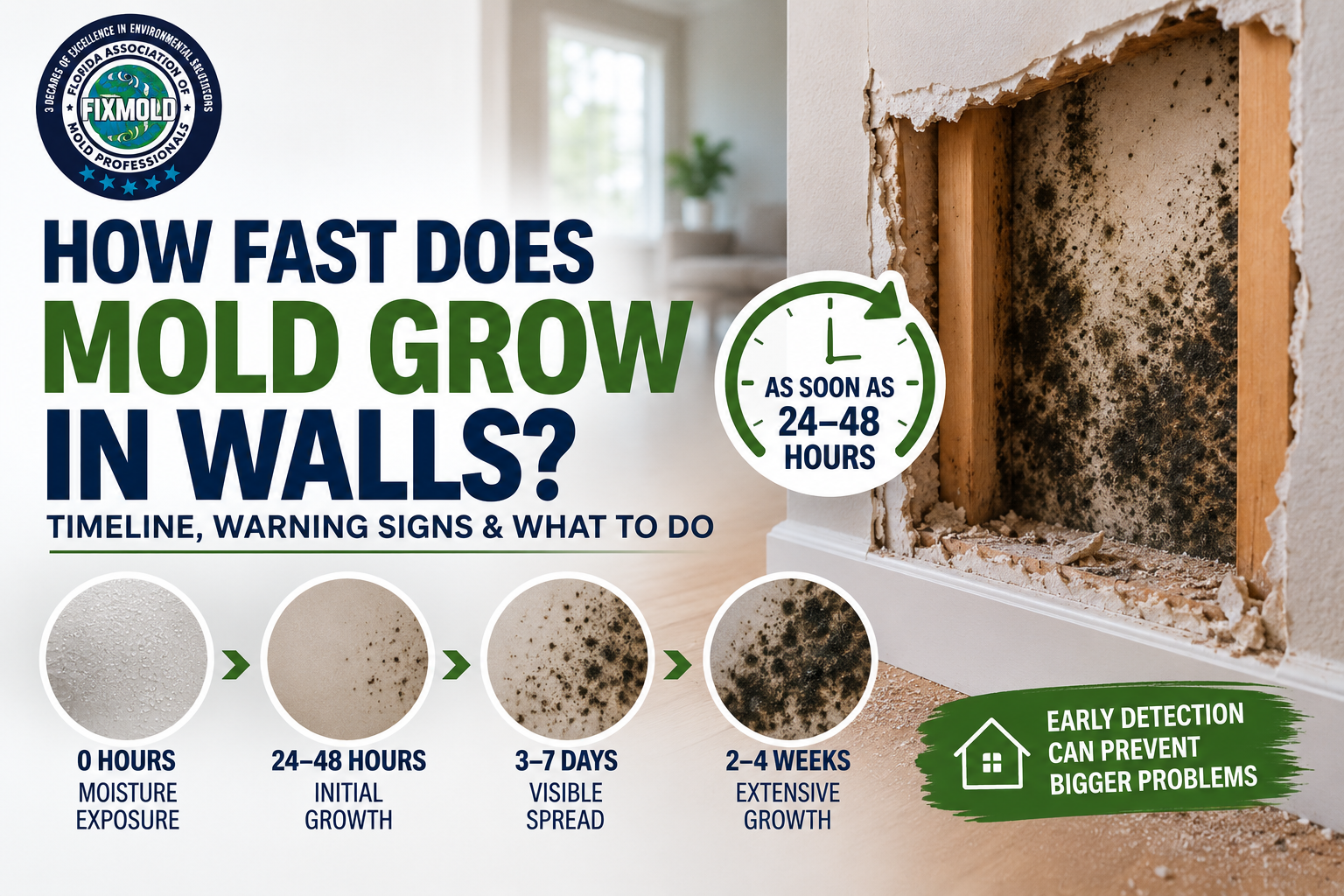
Most homeowners think of mold growth as something that happens over months. The reality inside wall cavities is considerably faster. Here is what actually happens after moisture enters a wall:
Hours 0 to 24: Mold spores present on building surfaces, which include virtually all indoor environments, begin absorbing moisture and initiating germination. No visible change occurs on the wall surface. The process is entirely invisible.
Hours 24 to 48: Germination completes, and hyphal growth begins. Hyphae are the root-like filaments that extend through building materials, anchoring the developing colony and beginning to break down organic material for nutrients. Still no visible indication from the exterior wall surface.
Days 3 to 7: Early colony formation produces the first microscopic concentrations of spores. Spore release into wall cavity air begins. The colony is not yet visible but may produce early microbial volatile organic compounds that a sensitive person might detect as a faint smell near the affected wall.
Days 7 to 14: Colonies become visible within the wall cavity as discoloration on the interior face of drywall and on wood framing. The exterior painted surface still shows no indication. Spore counts inside the wall cavity are now elevated and beginning to infiltrate indoor air through gaps around electrical outlets, baseboard gaps, and HVAC returns in the affected area.
Weeks 2 to 4: Active colonies expand across available moisture-affected surfaces. Multiple species may be present simultaneously. Paint on the exterior surface may begin showing faint staining or discoloration as the colony reaches the paper facing of the drywall. Musty odor becomes more detectable in the affected room.
Weeks 4 to 8: This is the stage we found in the Davie home. Established, active colonies covering extensive areas of wall cavity materials. Exterior wall surface showing visible staining, paint bubbling, or discoloration. Elevated spore counts detectable in indoor air throughout adjacent rooms. Health symptoms in sensitive household members frequently present at this stage.
Beyond 8 weeks: Structural degradation of building materials becomes a factor as sustained mold activity breaks down drywall integrity and can begin affecting wood framing moisture content and structural performance. Remediation scope and cost increase significantly at this stage compared to earlier intervention.
Why South Florida Accelerates This Timeline
National mold growth timelines are based on average conditions. South Florida’s average conditions are not average.
Average summer relative humidity in Miami-Dade, Broward, and Palm Beach County exceeds 80% for extended periods. Indoor temperatures in homes with HVAC issues or power outages reach the mid-to-upper 80s Fahrenheit, which is within the optimal growth temperature range for most mold species. Homes in this climate that experience any water intrusion event are operating closer to the fast end of every growth estimate rather than the slow end.
A 2021 review published in the journal Building and Environment confirmed that elevated ambient temperature and humidity accelerate every phase of indoor mold colonization, including germination speed, hyphal extension rate, and spore production volume. For South Florida homeowners, this means the national 48-hour guideline should be treated as a maximum, not a typical expectation.
Warning Signs That Mold Is Growing in Your Walls Right Now
Because how fast does mold grow in walls is a timeline that is almost entirely invisible during its most active early phases, knowing what signals to watch for is the practical tool that replaces the ability to see inside a wall.
1. Persistent Musty Odors That Won’t Go Away
A persistent musty odor that does not respond to cleaning, airing out, or deodorizing is the most reliable early indicator available to homeowners. Mold produces microbial volatile organic compounds as metabolic byproducts, and that earthy, stale smell is those compounds entering your indoor air even when the growth is hidden inside building materials. If the smell is strongest near a specific wall or in a specific corner, that location is telling you something important.
2. Bubbling, Peeling, or Stained Paint
Paint that is bubbling, peeling, or appears to be staining from behind rather than from the surface indicates moisture building up inside the wall assembly. Moisture in that location at that level means mold is almost certainly already established given the timeline above.
3. Soft or Spongy Walls
Walls that feel soft or spongy in specific areas indicate drywall that has absorbed moisture to the point of structural degradation. By this stage, mold growth inside the cavity is virtually certain.
4. Health Symptoms That Improve When You Leave Home
Health symptoms following a location pattern are among the most telling indirect signals. Respiratory symptoms, persistent headaches, and fatigue that consistently worsen at home and improve when away point to something in the indoor environment. The CDC documents this location-correlated symptom pattern as a meaningful indicator warranting environmental investigation. Understanding how to detect mold inside walls through both physical inspection and air quality testing gives homeowners and inspectors the tools to connect these health signals to a specific source.
5. Unexpected Increases in Energy Bills
Elevated energy bills without a clear explanation can indicate that wall insulation has become saturated with moisture, reducing its thermal performance. This is not a primary mold indicator, but it is a secondary signal worth noting when combined with other warning signs.
The Stats That Put This in Perspective
The scale of indoor wall mold as a residential problem is larger than most homeowners realize until they encounter it directly.
The EPA estimates that 50% of American homes have conditions conducive to mold growth, with moisture problems in building materials as the primary driver. Research from the American Journal of Public Health found that 21% of all current asthma cases in the United States are attributable to dampness and mold exposure in homes, representing approximately 4.6 million cases nationally with an estimated annual health cost of $3.5 billion.
A study published in Indoor Air found that occupants of water-damaged buildings are 50 to 75% more likely to experience respiratory illness than those in dry, well-maintained environments. The WHO’s analysis of damp building health effects found that 10 to 50% of indoor environments in developed countries have moisture and mold conditions significant enough to affect occupant health.
In South Florida specifically, the combination of climate factors, aging building stock, and the frequency of water intrusion events from storm activity means these national statistics likely underestimate the regional prevalence of wall mold in residential properties.
What You Should Do Based on the Timeline
The appropriate response to wall mold depends significantly on where you are in the timeline above, because the intervention required at day 3 is fundamentally different from the intervention required at week 8.
If you know water entered a wall cavity within the last 48 hours, the priority is immediate professional drying. Industrial dehumidifiers, moisture meters to verify dryness in building materials, and potentially opening the wall cavity to allow direct airflow are the tools that can interrupt the timeline before colony establishment occurs. This is the window where prevention is genuinely possible.
If you are past 48 hours but within the first two weeks, professional mold inspection is the appropriate next step. Moisture mapping and thermal imaging can identify the extent of moisture penetration and determine whether building materials need to come out to interrupt growth before it becomes extensive. Catching the situation at this stage typically means a significantly more limited remediation scope than waiting further.
If you are in the four- to eight-week range or beyond, the inspection scope needs to include air sampling in addition to moisture mapping because spore distribution into indoor air is already occurring. Professional mold testing with laboratory-certified results tells you what species are present, at what concentrations, and across what areas of the home. This information drives the remediation scope rather than allowing assumptions about how far the problem has spread.
If water intrusion was connected to flooding, the guidance in how to prevent mold after a flood covers the specific response protocols that apply to that scenario, including the material removal decisions that determine whether flood events become wall mold situations.
HVAC systems deserve specific attention regardless of which phase you are at. If moisture reached air handler components or ductwork, HVAC restoration needs to be part of the assessment because a contaminated air handling system distributes wall mold spores throughout every room in the home with every cycle. This is the mechanism that turns a localized wall mold problem into a whole-home air quality problem.
What Professional Inspection Adds That DIY Cannot
How fast does mold grow in walls is ultimately a question that matters because of what it means for how quickly you need to act and how accurately you need to assess the situation. Surface inspection answers some questions. Professional assessment answers the ones that matter most.
Calibrated moisture meters provide actual moisture content readings inside building materials rather than surface impressions. Infrared thermal imaging maps temperature differentials on wall surfaces that indicate moisture trapped inside cavities without requiring wall penetration at every location. Air sampling with laboratory analysis quantifies spore concentrations and identifies genera present, establishing whether indoor levels are elevated relative to outdoor baseline.
Mold inspection by a certified professional combines these tools into a comprehensive picture that tells you where the growth is, how far it has spread, what is sustaining it, and what remediation scope is needed to resolve it completely rather than partially. That picture is what protects your building materials, your remediation investment, and your family’s health.
Frequently Asked Questions
Q1: How fast does mold grow in walls after a leak?
Germination begins within 24 to 48 hours of sustained moisture exposure on building materials. Visible colony formation occurs within the wall cavity within 7 to 14 days. By weeks 4 to 8, established colonies covering extensive areas of drywall and framing are typical in moisture-affected wall cavities that were not professionally dried within that initial window. South Florida’s heat and humidity accelerate this timeline relative to national average estimates.
Q2: Can mold grow in walls without a visible leak?
Yes. Condensation inside wall assemblies, slow drips from plumbing connections inside wall cavities, moisture wicking through concrete block construction, and inadequately dried post-flood materials are all common sources of wall mold that produce no visible exterior leak indication. Thermal imaging and moisture meters identify these hidden moisture sources that visual inspection consistently misses.
Q3: How do I know if mold is growing in my walls right now?
The most reliable indicators are a persistent musty odor near a specific wall, paint bubbling or staining from behind, walls that feel soft in specific areas, and health symptoms that worsen at home and improve away. Air sampling with laboratory analysis is the tool that provides definitive, quantified evidence of active wall mold even before visible growth appears on exterior surfaces.
Q4: Is wall mold dangerous to my family?
Yes, at concentrations produced by established wall colonies. The CDC documents upper respiratory effects in otherwise healthy adults, and the American Journal of Public Health found a 40% increased asthma risk in children from mold-affected homes. Mycotoxin-producing species including Stachybotrys, Aspergillus, and Chaetomium produce neurological and immune effects in addition to respiratory ones. The health impact depends on species, concentration, duration of exposure, and individual susceptibility.
Q5: How much does wall mold remediation cost?
Cost depends on the extent of the affected area, the materials involved, and whether the moisture source requires correction as part of the project. Limited wall cavity remediation in a single room typically ranges from $1,500 to $4,000. Multi-room situations with extensive material involvement range from $4,000 to $12,000 or more. Early intervention when growth is less established consistently reduces remediation scope and cost relative to situations discovered at eight weeks or beyond.
Conclusion
How fast does mold grow in walls is a question with an answer that most homeowners find uncomfortably fast. Twenty-four to forty-eight hours to germination, one to two weeks to established colony formation inside the wall cavity, four to eight weeks to the kind of extensive growth we found in the Davie home. All of it is invisible from the outside until the wall itself starts showing signs that the process has been underway for some time.
The warning signs are readable if you know what to look for. The musty smell, the paint behavior, the soft wall, the health symptoms that improve when you leave. These are the signals that the timeline is already in progress and that the window for limiting the scope of the problem is narrowing.
Acting within that window, with accurate professional assessment rather than surface inspection and optimistic assumptions, is what consistently separates water damage events that resolve cleanly from those that develop into serious mold situations. The timeline does not wait for a convenient moment to address it.
If you are seeing any of the warning signs in this article or have experienced a water intrusion event in the past several weeks, contact Fixmold for a professional inspection. We use thermal imaging, moisture mapping, and laboratory-certified air sampling to give you an accurate picture of what is happening inside your walls before the timeline advances further.
Milly is a content contributor at FixMold with a focus on mold inspection, remediation strategies, air quality improvement, and property protection. She shares practical insights and educational resources to help homeowners and businesses maintain safer, cleaner indoor environments.