How to Detect Mold Inside Walls Before It Causes Serious Damage
milly g
July 2nd, 2026
No Comments
Like what we publish? Pin Fixmold Miami as a preferred source on Google.
Most homeowners only think about mold when they can see it. The problem is, the mold you can see is rarely the mold doing the most damage.
Hidden mold inside walls is one of the most underdiagnosed home health hazards in the United States. It grows silently behind drywall, inside insulation, along wooden studs, and within wall cavities, completely invisible from the outside while releasing mycotoxins into your indoor air around the clock. By the time visible signs appear on your walls, the colony has typically been active for weeks or months.
According to the EPA, mold can begin growing on a damp surface within 24 to 48 hours. The AIHA estimates that approximately 50% of U.S. homes have some form of hidden moisture problem, the primary driver of wall mold. A study published in Indoor Air found that occupants of water-damaged buildings are 50 to 75% more likely to experience respiratory illness than those living in dry, well-maintained homes.
Knowing how to detect mold inside walls before it spreads is not just about protecting your property. It is about protecting the people living inside it.
Why Mold Grows Inside Walls in the First Place
Before understanding how to detect mold inside walls, it helps to understand exactly why it ends up there. Walls create the perfect hidden environment for mold growth, offering darkness, limited airflow, and organic materials like wood and drywall paper that mold feeds on directly.
The most common causes include slow plumbing leaks behind pipes that go unnoticed for months, roof leaks that channel water down into wall cavities, condensation buildup in poorly insulated exterior walls, flooding or water intrusion events where walls were not fully dried within the critical 48-hour window, and HVAC condensation lines that overflow and saturate surrounding wall structures.
The dangerous reality is that none of these scenarios require a dramatic flood or a visible leak. A slow drip behind a kitchen cabinet can silently feed a mold colony for an entire year without a single external warning sign.
Early Warning Signs of Mold Inside Walls
Learning how to detect mold inside walls starts with recognizing the signals your home sends before the problem becomes catastrophic. These signs are easy to dismiss individually, but together they build a clear picture.
A persistent musty odor is the most reliable early indicator. Mold produces microbial volatile organic compounds (MVOCs) as metabolic byproducts, and these compounds create the distinctive earthy, musty smell associated with mold. If a room smells musty even after cleaning, airing out, and dehumidifying, the odor is coming from inside the wall, not from a surface.
Discoloration or staining on walls that does not match typical water damage patterns deserves serious attention. Yellowish-brown stains, dark streaks, or paint that appears stained from behind are frequently signs of mold colonies pushing against the interior surface of drywall.
Bubbling, peeling, or warping paint and wallpaper occurs when moisture behind the wall surface builds up enough to break the adhesion between the wall material and its coating. This is a physical sign that water is present inside the wall, and where water has been sitting, mold has almost certainly followed.
Walls that feel soft, spongy, or subtly damp to the touch indicate moisture saturation of drywall. Standard drywall deteriorates rapidly when wet and provides an ideal food source for mold growth. Any wall surface that flexes slightly under gentle pressure warrants immediate investigation.
Sudden worsening of respiratory symptoms indoors, including congestion, coughing, eye irritation, or headaches that improve when you leave the building, points to airborne spores entering your living space from a hidden source. When multiple household members experience similar symptoms without a shared illness, the indoor environment becomes the common denominator worth investigating.
How to Detect Mold Inside Walls: Step by Step
Step 1: Conduct a Systematic Visual Inspection
Begin at the most likely entry points for moisture. Check walls adjacent to bathrooms, kitchens, laundry rooms, and exterior-facing walls in basements. Look closely at baseboards, window frames, and areas below plumbing fixtures for staining, discoloration, or paint irregularities. Inspect the ceiling-to-wall junction because water traveling down from roof leaks often accumulates there first.
Do not overlook closets. Closets on exterior walls are chronically under-inspected and frequently develop mold due to limited airflow and temperature differentials that promote condensation.
Step 2: Use a Moisture Meter
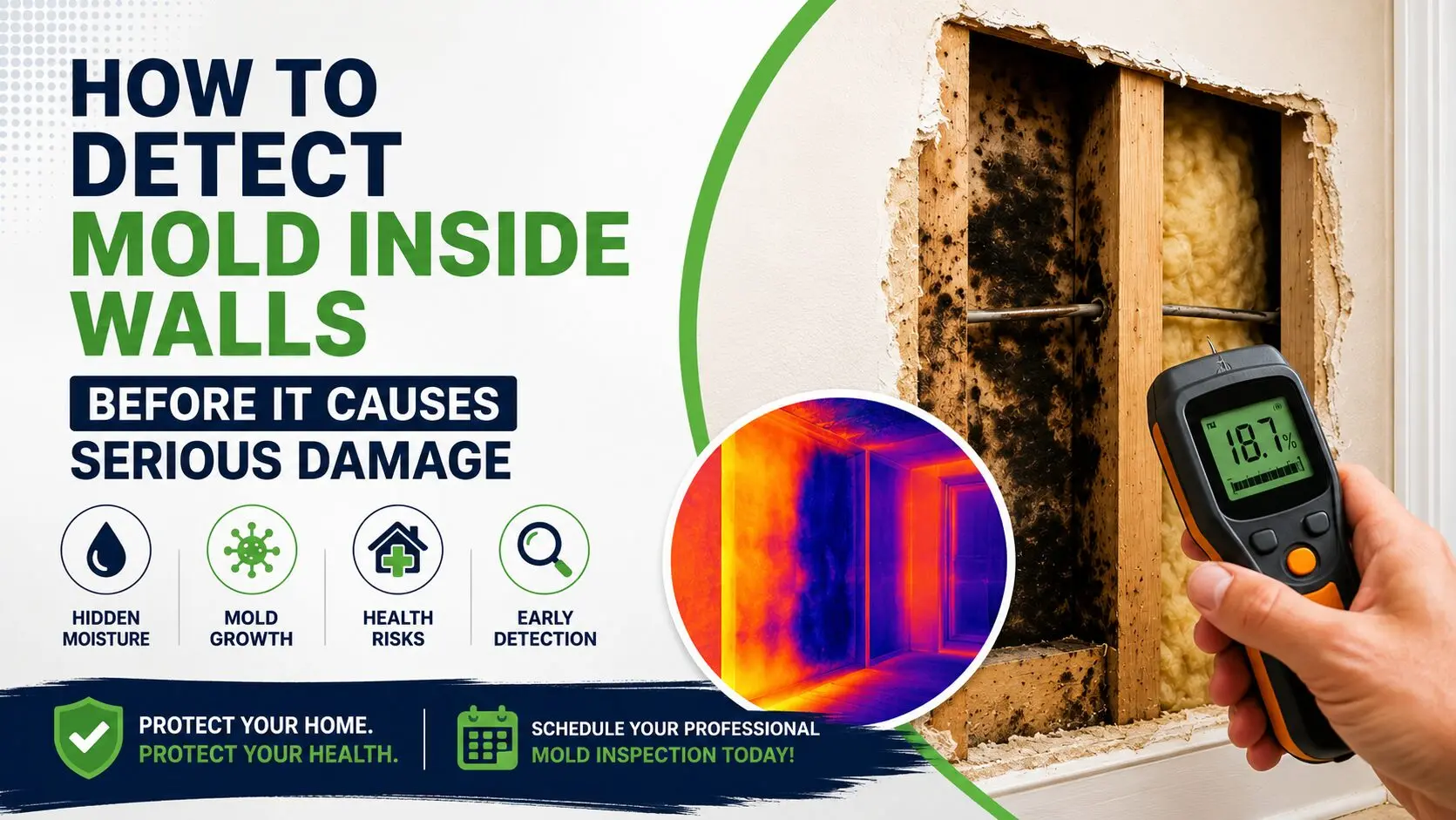
A moisture meter is the single most practical tool a homeowner can use to test for mold inside walls without opening them. Moisture meters measure water content within wall materials through probe-based or non-invasive scanning contact with the wall surface.
Readings above 16 to 17% moisture content in drywall or above 19% in wood indicate conditions actively conducive to mold growth. Readings above 20% in any wall material should be treated as a confirmed moisture problem requiring immediate investigation. Moisture meters are the first diagnostic tool FixMold technicians deploy on every inspection.
Step 3: Perform a Thermal Imaging Scan
Infrared thermal imaging cameras detect temperature differentials on wall surfaces. Moisture inside a wall cools at a different rate than dry material, creating a detectable thermal signature that shows up clearly on the camera display.
Thermal imaging can identify hidden moisture pockets inside walls, ceiling cavities, and floor structures without any drilling or demolition. It is one of the most effective non-invasive methods available for how to detect mold inside walls in its early stages, before physical damage becomes visible. Professional thermal imaging used by FixMold’s certified inspectors can locate moisture intrusion points invisible to the naked eye with remarkable precision.
Step 4: Conduct Air Quality Testing
Even when mold is completely hidden inside a wall, the spores it releases travel freely through the air of your living space. A professional mold testing company can use advanced air sampling and laboratory analysis to identify hidden contamination with greater accuracy. Air sampling captures and quantifies those spores, giving you measurable data on what you and your family are actually breathing every day.
Two primary methods are used in professional settings. Spore trap sampling collects airborne particles on a cassette that is sent to a laboratory for analysis. ERMI (Environmental Relative Moldiness Index) testing uses dust samples collected from the home to analyze the DNA of mold species present. The EPA has validated ERMI testing as a reliable method for evaluating mold burden in residential buildings.
An indoor spore count significantly elevated above outdoor baseline levels, particularly for water-damage-indicator species like Stachybotrys, Chaetomium, or Aspergillus/Penicillium, confirms active hidden mold even without any visible growth anywhere in the home.
Step 5: Use Mold Test Kits as a Supplementary Tool
Consumer mold test kits, available at most hardware stores, use either surface swabs or air collection plates to capture mold samples that are then sent to a laboratory. They are not a substitute for professional inspection, but they can serve as a useful screening step when you want preliminary information before scheduling a full assessment.
The important caveat is that a negative result from a consumer kit does not confirm the absence of mold. These kits test a very limited sample area and can produce false negatives in cases of fully contained wall mold with limited spore dispersal. They are best used alongside moisture readings and professional air quality testing, not instead of them.
Step 6: Borescope Inspection
A borescope, which is a small flexible camera on a cable, can be inserted through a small drilled hole, typically about 3/8 inch wide to visually inspect the interior of a wall cavity without full demolition. This method allows direct visual confirmation of mold growth on wall studs, insulation, and the back face of drywall.
Borescope inspection is particularly valuable when moisture meter and air quality data both indicate a problem, but the exact location needs to be confirmed before certified mold remediation begins.
A small access hole is infinitely preferable to unnecessary wall removal, and the opening can be patched cleanly after inspection is complete.
How to Test for Mold Inside Walls: Methods Compared
Testing Method
What It Detects
Invasive?
DIY Possible?
Reliability
Visual Inspection
Surface staining, paint damage
No
Yes
Low: misses hidden growth
Moisture Meter
Moisture levels in wall materials
No
Yes
Moderate: confirms conditions
Thermal Imaging
Hidden moisture pockets
No
Limited
High: professional-grade accuracy
Air Quality Sampling
Airborne spore concentration
No
Partial
High: lab-verified results
Consumer Mold Test Kit
Surface or airborne mold presence
No
Yes
Low to Moderate: limited sample area
Borescope Inspection
Direct visual of the wall interior
Minimally
No
Very High: direct confirmation
Professional Inspection
Full assessment, all methods combined
Minimally
No
Highest: comprehensive diagnosis
What Happens When Wall Mold Goes Undetected?
The consequences of missing wall mold compound significantly over time. Structurally, mold degrades wood framing, breaks down drywall integrity, and can compromise load-bearing elements when colonies are large and long-established. The EPA estimates that water damage and mold remediation costs average $2,300 for minor cases but can exceed $30,000 when structural damage is involved.
From a health standpoint, prolonged exposure to hidden wall mold dramatically increases the risk of chronic respiratory illness, neurological symptoms, and immune system dysregulation, particularly in children, the elderly, and individuals with the HLA-DR genetic variant that prevents natural mycotoxin clearance.
Insurance implications matter too. Many homeowners’ insurance policies exclude mold damage that resulted from a long-term, slow moisture problem rather than a sudden event. Detecting and documenting mold early, before it becomes extensive, supports a much stronger insurance claim position.
When to Call FixMold Instead of Investigating Alone
DIY inspection methods give you valuable early indicators, but they have hard limits. Consumer tools cannot quantify spore species, cannot map the full extent of moisture infiltration behind multiple wall surfaces, and cannot determine whether a mold colony has spread into adjacent structural cavities.
FixMold’s certified mold inspectors bring the full professional toolkit to every job, including calibrated moisture meters, infrared thermal imaging cameras, ERMI-grade air sampling equipment, and borescope technology. More importantly, they bring trained interpretation of what those readings mean together, because a single elevated reading tells a different story than three converging indicators pointing to the same wall cavity.
If your home has experienced any water intrusion event, if multiple household members are experiencing unexplained health symptoms, or if something about a wall just does not feel right even though it looks fine, do not wait for visible confirmation. By the time mold becomes visible on a wall surface, it has already been growing for weeks.
Contact FixMold, a trusted mold remediation company, for a comprehensive inspection and get a complete, honest picture of what is actually inside your walls.
Frequently Asked Questions (FAQs)
Q1: How can you tell if there is mold inside your walls without cutting them open?
Several non-invasive methods help you understand how is mold detected inside walls without any demolition. A moisture meter detects elevated water content in wall materials, the primary condition mold requires to survive. Thermal imaging cameras identify hidden moisture pockets by detecting temperature differentials across wall surfaces. Air quality sampling measures airborne spore concentrations that indicate an active mold source even when growth is fully concealed. A persistent musty odor that remains despite cleaning is itself a reliable early indicator. Together, these methods allow FixMold’s inspectors to assess hidden mold with a high degree of confidence before any wall is opened.
Q2: How is mold detected inside walls by professionals?
Professional mold detection combines multiple diagnostic methods used in sequence. The process typically begins with a detailed visual inspection and moisture mapping using calibrated meters. Thermal imaging is used to identify temperature anomalies indicating hidden moisture. Air and surface sampling is then conducted, with samples sent to an accredited laboratory for spore identification and quantification. Where air data suggests concentrated mold growth, a borescope camera is inserted through a small access hole to provide direct visual confirmation of the wall cavity interior. This layered approach is what separates professional detection from consumer test kits, as each method validates and refines the findings of the previous one.
Q2: Can mold inside walls make you sick even if you cannot see it?
Yes, and this is precisely what makes hidden wall mold so dangerous. Understanding how to detect mold inside walls early is critical because mold releases spores and mycotoxins continuously, regardless of whether it is visible. These particles travel through wall gaps, electrical outlets, and HVAC systems into the living spaces of your home. Chronic exposure to hidden mold has been directly linked to respiratory illness, cognitive impairment, immune suppression, fatigue, and neurological symptoms, all without the occupant ever seeing a single mold spot.
Q3: How long does mold take to grow inside a wall after water damage?
The EPA’s research indicates that mold can begin colonizing a damp surface within 24 to 48 hours under favorable conditions. Wall cavities provide ideal conditions, including darkness, organic material, and limited airflow. A slow leak that goes unaddressed for even two weeks can produce an established mold colony. After 30 days of continuous moisture, mold growth inside a wall is virtually guaranteed, and after 60 days, structural material degradation typically begins.
Q4: Is it safe to stay in a home with mold inside the walls?
This depends on the species present, the size of the colony, and the vulnerability of the occupants. Small, contained mold growth may pose limited immediate risk to healthy adults. However, toxigenic species like Stachybotrys chartarum or large Aspergillus colonies can create genuinely hazardous indoor air conditions. Children, the elderly, pregnant women, and individuals with respiratory conditions or compromised immunity face elevated risk at lower exposure levels. If professional testing confirms active hidden mold, temporary relocation during professional remediation is strongly advisable for vulnerable household members.
Q5: How much does professional mold detection inside walls cost?
Knowing how to test for mold inside walls professionally starts with understanding the cost involved. Basic visual inspections with moisture mapping typically range from $200 to $600. Comprehensive inspections, including thermal imaging and laboratory air sampling, typically range from $400 to $1,000. These costs are minimal relative to the average remediation cost for late-stage wall mold, which can reach $10,000 to $30,000 when structural damage is involved. Early professional detection is consistently the most cost-effective investment a homeowner can make.
Q6: What should I do immediately if I suspect mold inside a wall?
Stop adding moisture to the area first. Fix any known leaks, eliminate condensation sources, and improve ventilation. Do not attempt to cut into the wall yourself, as this can release large quantities of spores into your living space without proper containment. Avoid using bleach on wall surfaces because it does not penetrate drywall to address mold growing on the interior face. While many homeowners search for the best mold remover for walls, hidden mold inside wall cavities usually requires professional inspection and remediation rather than surface cleaning alone. Document any visible staining, odors, or symptoms with dates. Then contact FixMold for a professional inspection because the earlier a comprehensive assessment is conducted, the more contained and manageable the remediation will be.
milly g
Milly is a content contributor at FixMold with a focus on mold inspection, remediation strategies, air quality improvement, and property protection. She shares practical insights and educational resources to help homeowners and businesses maintain safer, cleaner indoor environments.