Last September, I walked into a home in Pembroke Pines three weeks after the owner had dealt with about four inches of flooding from a backed-up drainage system. He was proud of how quickly he had handled it. Rented a shop vac, ran fans for five days, repainted the baseboards, and put the furniture back. The house looked completely normal.
It smelled like a wet dog that had been locked in a closet.
Behind the drywall on the north wall of his living room, the one that backed up against the garage where the water had entered, we found Aspergillus and Penicillium colonies covering an area roughly the size of a queen mattress. His eight-year-old had been using her asthma inhaler twice as often as usual for the past two weeks. He had no idea the two things were connected.
I have been doing this work in South Florida long enough to recognize this situation before I even open a wall. The smell tells you. The health symptoms tell you. And the homeowner’s confidence that they handled it tells you the most of all, because the ones who are most certain they fixed it properly are usually the ones who did not.
If you are reading this after a flood, here is what you actually need to know.
Why the 48-Hour Window Is the Most Important Number You Will Read Today
FEMA’s guidance on flood recovery states that mold growth begins within 24 to 48 hours of water exposure. In most parts of the country, that timeline is accurate. In South Florida, where average summer humidity sits above 80% and indoor temperatures in a home without functioning AC can climb into the upper 80s within hours, that window is sometimes shorter.
This is not a statistic to file away for later. It is the number that determines whether what you are dealing with is a cleanup or a mold remediation project, and the difference between those two things in terms of cost, disruption, and health impact is significant.
The reason the timeline is so compressed comes down to what floodwater actually does to building materials. Drywall, which is what the interior walls of virtually every Florida home are made from, consists of gypsum sandwiched between two layers of paper facing. That paper is a cellulose product. Mold feeds on cellulose. When drywall absorbs water, which it does rapidly and deeply, it becomes a food source sitting in a warm, dark, enclosed space with limited airflow.
You cannot rush mold growth once those conditions are in place. You can only remove the conditions that make it possible.
The Steps That Actually Matter, In the Right Order
Getting the Water Out First
This sounds obvious until you are standing in a flooded home at 10 pm trying to figure out what to do. The priority before anything else is water extraction, and I mean aggressive extraction, not mopping and hoping for the best.
Wet/dry vacuums work for small areas. For anything beyond a bathroom or small laundry room, you need a submersible pump or a professional extraction setup. Every hour that standing water sits in contact with your floor and baseboards is another hour of moisture penetrating deeper into the subfloor, the wall cavities, and the structural framing.
Do not wait until morning. Do not wait until the water recedes on its own. Active extraction is the first and most time-sensitive step in how to prevent mold after a flood, and everything else builds on how well and how quickly you execute it.
Dehumidification Is Not the Same Thing as Running Fans
This is the mistake I see most often, and it costs people more than almost any other decision they make in the first 48 hours.
Fans circulate air. They move moisture around the room and help surface evaporation. They do not remove moisture from the air or from inside building materials. Running fans without dehumidification in a South Florida home after flooding is roughly equivalent to leaving wet clothes in a pile and expecting them to dry because you turned on a ceiling fan.
Dehumidification actually pulls moisture out of the air, which drops the relative humidity in the space and accelerates moisture release from saturated materials. The EPA recommends keeping indoor humidity below 50% generally and lower than that during flood recovery. In South Florida, that target requires industrial dehumidifiers, not residential units from the hardware store, because the volume of moisture in the air and in the materials typically exceeds what consumer equipment can handle.
Run dehumidifiers continuously. Empty drainage containers as needed or use units with automatic drainage. Check the humidity with a hygrometer rather than guessing.
The Hard Conversation About Saturated Materials
Nobody wants to hear that their flooring needs to come out or that the drywall behind their cabinets has to go. I understand that. I have had this conversation with homeowners hundreds of times, and it is never the one they were hoping to have.
But the reality is that porous materials, including carpet and carpet padding, drywall that absorbed flood water, ceiling tiles, and fiberglass insulation that got wet, cannot be reliably dried in place within the window that prevents mold growth from establishing. They need to come out.
The specific problem with trying to dry saturated drywall in place is that the paper facing on the exterior surface dries relatively quickly with airflow while the interior of the wall cavity stays wet. You end up with a wall that feels dry and looks fine while the conditions behind it are exactly what mold needs to establish a colony. This is what happened in Pembroke Pines. The homeowner dried the surface. The inside of the wall never dried at all.
Removing materials that cannot be adequately dried is not an admission of defeat. It is the decision that prevents a four-figure cleanup from becoming a five-figure remediation project three months later.
Cleaning and Disinfecting What Remains
After extraction, dehumidification, and material removal, hard non-porous surfaces, including concrete floors, metal framing, and sealed concrete block walls, need to be cleaned with detergent and water before antimicrobial disinfection.
South Florida floodwater is not clean water. Storm surge, drainage overflow, and groundwater intrusion all carry contamination that needs to be addressed as a separate step from mold prevention. Treat every flood-affected surface as potentially contaminated and use appropriate protective equipment, including gloves, rubber boots, and an N-95 respirator, throughout cleanup work.
The CDC recommends cleaning with detergent before applying any disinfectant because organic material on surfaces inactivates many disinfectants before they can do their job. Clean first, then disinfect, in that order.
Checking Your Work With the Right Tools
Here is where many otherwise well-executed flood responses fall short. Homeowners finish their cleanup, surfaces feel dry, and they move to repairs and repainting. Two months later, they call us with a mold problem.
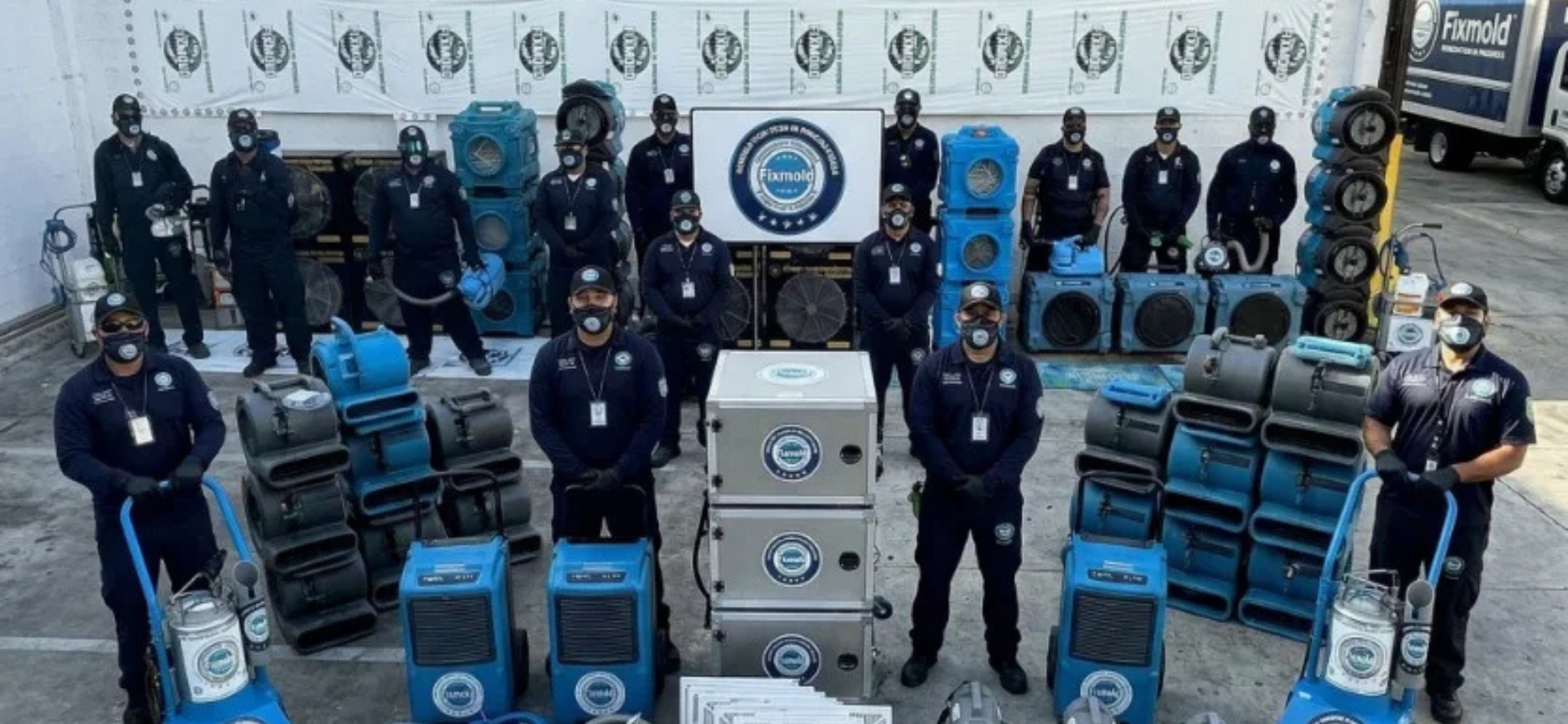
Moisture meters measure the actual water content inside building materials rather than relying on how a surface feels to the touch. Wood framing needs to be below 19% moisture content before it is safe to enclose. Drywall should be below 16%. These are not arbitrary numbers. They represent the threshold above which mold growth becomes viable in those specific materials.
At Fixmold, our team uses calibrated moisture meters and infrared thermal imaging cameras on every post-flood inspection because those tools show us what eyes and hands cannot detect. Infrared imaging identifies temperature differentials on wall surfaces that indicate trapped moisture inside wall cavities without needing to open the wall in every location. It maps the problem rather than sampling it randomly.
Confirming dryness before rebuilding is the step that separates flood response that actually prevents mold from flood response that delays the discovery of it.
Specific Situations That Need Special Attention
Your HVAC System After a Flood
Do not turn your air conditioning system on after flooding until it has been inspected. This is the instruction that homeowners most consistently ignore, usually because the house is hot and humid and the temptation is overwhelming.
If flood water reached your air handler, the condensate drain pan, or any portion of your ductwork, operating the system distributes contaminated air throughout every room in the house. A mold colony in an air handler or duct system affects the entire building rather than the isolated area where the flood occurred. Professional HVAC inspection after flooding is not optional if you want to prevent mold after flooding from spreading beyond the initially affected area.
Preventing Mold in a Basement After Flood
South Florida does not have many true basements, but below-grade utility spaces, garage areas at grade level, and homes built on slabs with enclosed under-home crawlspaces all share the characteristics that make basement flood situations particularly challenging.
Below-grade spaces lack natural ventilation. They are frequently surrounded by saturated soil that continues transmitting moisture through foundation walls and floor slabs for days or weeks after standing water is removed. A concrete floor that appears dry may still be wicking ground moisture through capillary action continuously.
Continuous dehumidification in below-grade spaces is more critical than anywhere else in the home. Check sump pump function if you have one. Inspect the perimeter drainage to confirm water is being directed away from the foundation. Any organic materials, including cardboard boxes, paper items, wood furniture, and fabric storage that contacted flood water in a below-grade space, should be removed rather than dried in place.
What Professionals Look For That Homeowners Miss
After years of doing this work in Miami-Dade, Broward, and Palm Beach County, the things that consistently lead to mold problems are not dramatic oversights. They are the details that feel minor in the moment.
The area behind the refrigerator that nobody thought to check. The section of wall inside the closet where the baseboard meets the floor. The cabinet toe kicks are at floor level in the kitchen. The HVAC return vent near the floor sat in standing water for several hours. The attic access panel that allowed humidity to climb into the attic space during the post-flood ventilation effort.
Mold does not care about the areas that are convenient to inspect. It grows where moisture is present, and moisture migrates to every part of a building it can reach during a flooding event.
Professional mold inspection after flooding includes a systematic examination of all of these secondary areas rather than focusing only on the obviously affected spaces. Fixmold has helped homeowners throughout South Florida identify moisture pockets in areas they never would have thought to check, weeks before those areas would have become visible mold problems.
The Mistakes That Turn a Flood Into a Mold Problem
Painting over water-stained surfaces before drying is complete. Paint seals moisture inside building materials rather than allowing it to escape. The wall looks repaired. The mold grows behind the paint in conditions that are now more enclosed and harder to detect.
Running the HVAC immediately to dry the space out. The system distributes rather than removes moisture and contaminates ductwork in the process.
Keeping saturated materials in the space during drying. A wet carpet left rolled up in the corner of the room during the drying process continuously re-humidifies the space and counteracts every hour of dehumidifier operation.
Assuming the smell will go away. A musty odor that persists after apparent drying is complete is active mold growth. It does not fade with time. It intensifies as the colony expands.
Rebuilding before confirming moisture levels with meters. This is the single most common mistake that leads to serious mold problems after what appeared to be a successful flood response.
When You Need Professional Help and Not Just Good Intentions
Call a professional when flooding involves anything other than clean water, when the affected area extends into wall cavities or structural framing, when HVAC components were involved, when household members are experiencing health symptoms that correlate with time spent at home, or when you simply cannot get dehumidifiers and extraction equipment on site within the first several hours.
Professional mold testing provides laboratory-confirmed evidence that spore levels are within acceptable ranges before you seal walls and return to normal occupancy. This documentation matters for insurance claims, real estate disclosures, and your family’s peace of mind.
Frequently Asked Questions
Q1: How quickly does mold actually grow after a flood in Florida specifically?
FEMA documents mold growth beginning within 24 to 48 hours nationally. In South Florida, where heat and humidity create near-ideal conditions year-round, active growth can establish at the lower end of that range or faster in enclosed spaces like wall cavities that trap moisture effectively. Beginning water extraction within the first few hours of a flood event is the most impactful single step available to homeowners.
Q2: Can I use bleach to prevent mold after flooding?
Bleach is effective on hard, non-porous surfaces, including tile, concrete, and glass, when used after cleaning with detergent. The CDC does not recommend bleach as a primary treatment for porous materials like drywall and wood because it does not penetrate deeply enough to address mold growth inside the material. For porous materials that were significantly saturated, removal is generally more reliable than surface treatment.
Q3: How do I know if my walls are dry enough to close up after flooding?
Touch and visual inspection are not reliable indicators of moisture content inside building materials. Moisture meters provide the actual data needed to make this determination. Wood framing should read below 19% and drywall below 16% before enclosure. If you do not have access to moisture meters, waiting longer than you think you need to is significantly safer than rebuilding too soon.
Q4: My home flooded three weeks ago, and I just noticed a smell. Is it too late to prevent mold?
If you are noticing a persistent musty odor three weeks after flooding, mold growth has almost certainly already established somewhere in your building materials. The appropriate response at that point shifts from prevention to mold assessment and remediation. A professional inspection with air and surface sampling will identify where growth is present and inform the remediation scope. Addressing it now is significantly less costly than waiting further.
Q5: Should I run my AC after flooding to reduce humidity?
Not until the system has been professionally inspected. If any portion of the HVAC system contacts flood water, operating it distributes contaminated air throughout the home and potentially introduces mold spores into ductwork that was previously clean. Use standalone dehumidifiers rather than the central HVAC system for humidity control during the flood recovery period.
Conclusion
How to prevent mold after a flood comes down to a sequence of decisions that need to happen quickly and in the right order. Extract water immediately. Dehumidify aggressively with appropriate equipment. Remove saturated porous materials rather than attempting to dry them in place. Clean and disinfect what remains. Verify dryness with moisture meters before rebuilding. And treat your HVAC system as a contamination risk until it is confirmed clean.
South Florida’s climate does not give you extra time after a flood. The heat and humidity that make this part of the country worth living in are also the conditions that accelerate everything that goes wrong after water gets into your home. The families and homeowners who come out of flood events without mold problems are the ones who take the 48-hour window seriously from the first hour, not the ones who wait to see how things develop.
A Note From Fixmold
If you are dealing with the aftermath of a flood and want a clear, accurate picture of whether your home is genuinely dry and safe before you start rebuilding, the team at Fixmold can help. We inspect flood-affected properties throughout South Florida using thermal imaging, calibrated moisture meters, and laboratory-supported air sampling to tell you exactly what is happening inside your building materials, not just what the surface suggests.
Contact Fixmold to schedule an inspection. Getting the right information early is always less expensive than finding out later.
Milly is a content contributor at FixMold with a focus on mold inspection, remediation strategies, air quality improvement, and property protection. She shares practical insights and educational resources to help homeowners and businesses maintain safer, cleaner indoor environments.