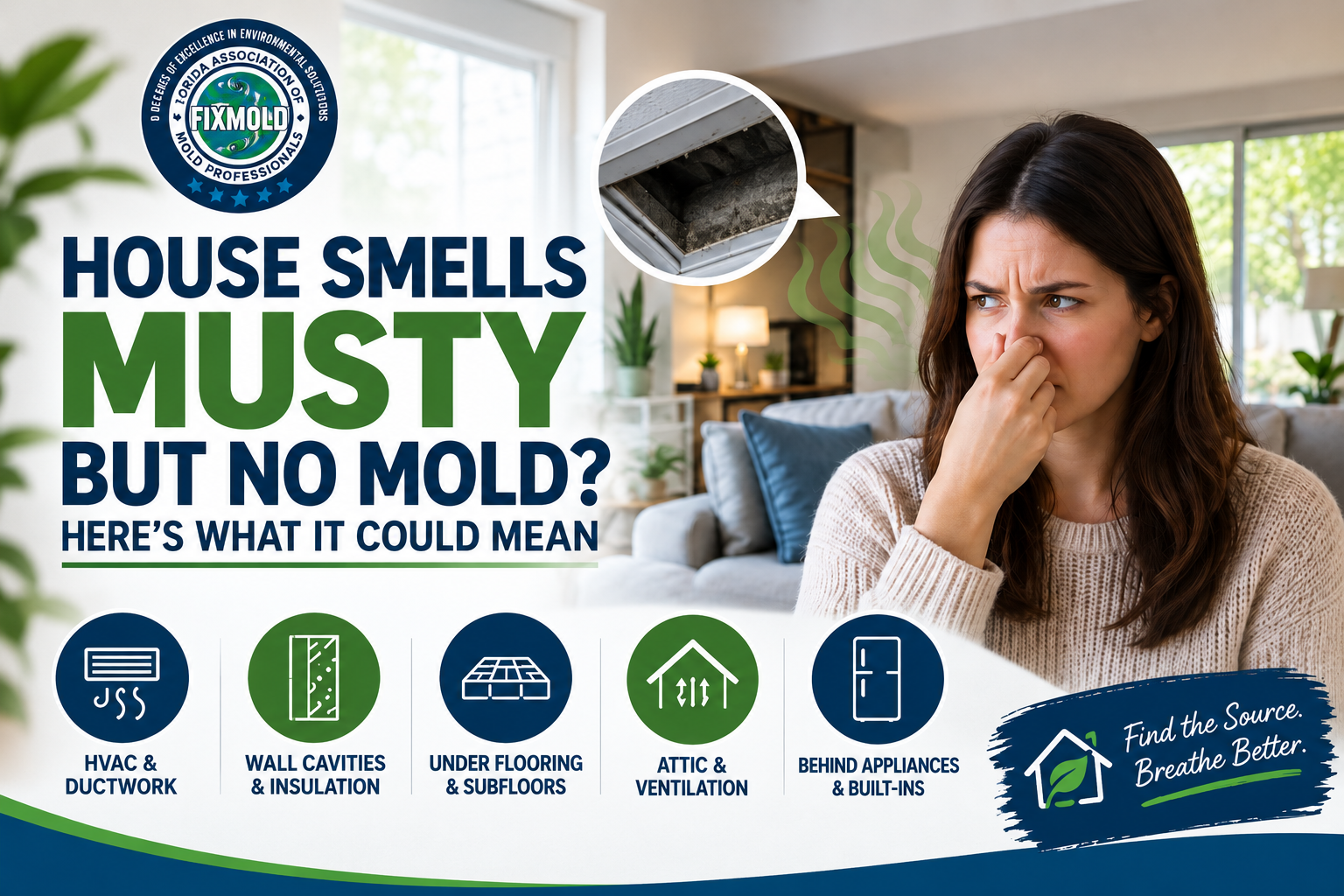
House Smells Musty But No Mold? Here’s What It Could Mean
milly g
September 16th, 2026
No Comments
Like what we publish? Pin Fixmold Miami as a preferred source on Google.
Last year, a homeowner in Plantation called us after spending nearly $1,400 trying to fix a smell she could not locate. New paint. Professional cleaning. Carpet shampooing. Three days after each attempt, the smell came back.
When we walked in, I knew within thirty seconds it was not coming from any surface. There is a specific quality to MVOC odor: the chemical compounds mold releases as it grows — that is different from surface dampness or mildew on grout. It has depth to it. It seems to come from the air itself.
We found the source under her floating hardwood floor in the northwest corner of the room. A hairline crack in the slab was wicking ground moisture upward, sustaining microbial growth on the underside of the flooring underlayment. Completely invisible from above. Producing the smell that had been driving her quietly mad for seven months.
She had been cleaning around a problem that no amount of cleaning was ever going to touch.
Why Your House Smells Musty But No Mold Is Visible
This is where most people get confused. If mold is causing the smell, why cannot you see it?
The smell is not mold itself. It is a chemical byproduct of mold’s metabolic activity called microbial volatile organic compounds, MVOCs. These are gaseous compounds that pass through building materials, travel through air gaps around electrical outlets and baseboards, and circulate through HVAC systems before reaching your living space as that distinctive earthy smell.
The mold colony producing them stays hidden inside a wall cavity, under flooring, above a ceiling panel, or inside an air handler. The compounds travel to you. The colony stays exactly where it is.
The EPA confirms in its indoor air quality guidance that musty odors in buildings are a reliable indicator of mold or moisture problems even when no visible growth is present. Not seeing mold is not reassurance. It simply tells you where the growth is not located, not that it does not exist.
How Common Is This Problem?
The scale of hidden moisture and mold problems in American homes is larger than most people realize until they encounter it personally.
Statistic
Source
50% of U.S. homes have conditions conducive to mold growth
EPA
21% of current U.S. asthma cases linked to indoor dampness and mold
American Journal of Public Health
$3.5 billion estimated annual health cost from mold-related asthma
American Journal of Public Health
Occupants of water-damaged buildings are 50-75% more likely to develop respiratory illness
Indoor Air Journal
10 to 50% of indoor environments in developed countries have dampness affecting health
WHO
MVOC exposure at indoor concentrations linked to headaches, fatigue, and nasal irritation
Environmental Health Perspectives
In South Florida where average summer humidity exceeds 80% and temperatures support year-round mold activity, these national figures likely underestimate the actual regional prevalence.
Where the Smell Is Actually Coming From
After working with hundreds of South Florida homes presenting with this exact complaint, hidden musty smell sources fall into consistent patterns.
1. HVAC Systems and Ductwork
HVAC systems and ductwork are the source I find most consistently when the smell seems to come from everywhere simultaneously. Air handlers accumulate organic material on evaporator coils and in condensate drain pans over time. When the system runs, it pulls air across that contaminated surface and distributes MVOCs through every supply vent in the home. Homeowners clean every room and the smell persists because the source is in the machine delivering air to those rooms, not the rooms themselves.
If the smell intensifies noticeably when the air conditioning turns on, the source is almost certainly in the HVAC system. That timing alone is one of the most useful diagnostic signals available without any professional equipment.
2. Hidden Mold Inside Wall Cavities
Inside wall cavities along exterior walls is the second most common source in South Florida homes. The air conditioning dynamics in this climate create condensation conditions that do not exist the same way in most of the country. Hot humid outdoor air infiltrates wall assemblies and contacts interior surfaces cooled by aggressive AC on the other side. That temperature differential produces condensation inside the wall assembly repeatedly over weeks and months. The wall surface feels dry. The paint looks fine. But inside the cavity, moisture is sustaining MVOC-producing microbial growth.
3. Mold Under Flooring and Subfloors
Under flooring in slab-on-grade construction is where the Plantation situation fell. Concrete slabs are porous and wick ground moisture upward through capillary action, particularly in areas with South Florida’s high water tables. When the vapor barrier between the slab and flooring material has aged or failed, microbial growth on the underside of flooring materials produces smell that travels upward into the living space with no surface indication above.
Floors with a slight spring in specific spots, tile with grout darkening without explanation, and carpet that feels subtly cooler underfoot in isolated areas are physical signals of subfloor moisture worth investigating.
4. Attic Moisture and Poor Ventilation
Attic spaces with poor ventilation produce MVOCs that migrate downward through recessed lights, HVAC penetrations, and ceiling drywall. South Florida attics reach temperatures above 140 degrees Fahrenheit in summer. When ventilation is inadequate, moisture accumulates in insulation and on roof sheathing and supports microbial growth that fills the living space with musty odor from above.
5. Mold Behind Appliances and Built-In Structures
Behind large appliances and built-in structures receive no airflow and no inspection during routine cleaning. The wall behind a refrigerator, the area behind a washing machine in place for years, and spaces enclosed by built-in furniture are locations where slow appliance condensation and undetected supply line drips sustain microbial activity indefinitely.
Can This Smell Make You Sick?
Yes, and the effects are more consistent than most people expect.
Research in the International Journal of Environmental Research and Public Health identified associations between elevated indoor MVOC exposure and headaches, fatigue, nasal irritation, and eye discomfort in building occupants. Beyond the MVOCs themselves, the active mold growth producing them is also releasing spores into your indoor air.
The CDC does not establish a safe indoor spore concentration because individual responses vary significantly. A concentration that causes mild irritation in one household member may produce persistent sinus infections in another. Children, the elderly, and anyone with respiratory conditions or immune vulnerabilities respond at lower exposure thresholds than healthy adults.
The homeowner in Plantation had been waking up with a scratchy throat every morning for six months before she called us. She had attributed it to dry air from the AC. After we resolved the subfloor moisture issue and the smell cleared, the morning scratchy throat stopped within ten days. She had been living with a low-level respiratory irritant every day without connecting it to her environment.
Why Cleaning Never Fixes It
Cleaning addresses surface contamination. MVOCs come from growth inside building materials and mechanical systems. No surface cleaning changes what is happening inside a wall cavity, under flooring, or inside an air handler.
Air fresheners suppress the perception temporarily. The source continues producing MVOCs regardless of what you spray in the room. The smell returns because nothing about the underlying condition changed.
This is why a room smells musty, but no mold is visible even after thorough cleaning in many South Florida homes. The cleaning is happening in the wrong location relative to the source.
How Professionals Find the Source
Three tools make professional investigation different from homeowner investigation in meaningful ways.
Moisture meters measure actual water content inside building materials and produce real numbers. A reading above 16% in drywall or above 19% in wood framing identifies a moisture problem that the painted surface directly in front of you gives no indication of whatsoever.
Infrared thermal imaging cameras detect temperature differentials on wall and floor surfaces. Moisture inside a building assembly changes how that section absorbs and releases heat, creating a visible thermal signature that maps the location of moisture problems without requiring any wall penetration.
Air sampling with laboratory analysis quantifies spore concentrations in your indoor air and compares them to outdoor baseline samples taken simultaneously. When indoor concentrations significantly exceed outdoor baseline, that result identifies active indoor growth even without a visible source. Professional mold testing through laboratory analysis also identifies which genera are present, which informs both the health context and the appropriate remediation approach.
Understanding how to detect mold inside walls through these methods is what allows professionals to confirm a source location before making any decisions about opening building materials. This protects homeowners from unnecessary damage during investigation.
If the source turns out to be the HVAC system, HVAC restoration addresses the contamination in the distribution equipment rather than just cleaning the vents, which is the surface-level version of the same mistake homeowners make when cleaning room surfaces.
A Quick Check Before Calling Anyone
Before scheduling professional service, these checks cost nothing and occasionally identify the source without anything further.
Pull the refrigerator away from the wall and inspect behind it. Open the cabinet under every sink and examine the back wall and base. Shine a flashlight into HVAC supply vents. Note whether the smell is strongest when the AC starts running or strongest in the morning before it has run. Walk the perimeter of affected rooms at floor level and notice whether the smell concentrates anywhere specific.
Check indoor humidity with a basic hygrometer. South Florida homes should stay below 60% relative humidity consistently. Regular readings above that indicate either an undersized AC system, a malfunctioning unit, or a clogged filter that has reduced dehumidification capacity, all of which can be addressed before mold investigation is needed.
If these checks find nothing, the next step is professional inspection with moisture mapping, thermal imaging, and air sampling, not more cleaning.
Frequently Asked Questions
Q1: My house smells musty, but no mold is visible anywhere. Is mold definitely present?
Almost certainly yes. MVOCs are produced by living, actively growing mold colonies, not by dormant spores or residual odors. The colony is present somewhere in the building that visual inspection has not reached. The EPA confirms that musty odors in buildings reliably indicate mold or moisture problems warranting investigation.
Q2: Why does one room smell musty but no mold is visible while the rest of the house is fine?
Localized smell in a single room is one of the most useful diagnostic signals available because it narrows the investigation significantly. The source is almost certainly in the wall cavities of that room, in the subfloor, in an HVAC component serving that zone, or behind a large appliance in that space. A professional inspection focused on that room typically identifies the source efficiently.
Q3: My house smells like mildew, but no mold is visible after a previous water event. Are those connected?
Almost always yes. A water intrusion event that was not professionally dried and moisture-verified is the most common precursor to the hidden mold situations behind persistent musty smells. Even if the event seemed minor and was cleaned up promptly, building materials that were not confirmed dry with moisture meters frequently retain enough moisture to support ongoing microbial growth. Understanding how to prevent mold after a flood includes the drying verification steps that prevent this specific outcome.
Q4: Will ventilation fix a persistent musty smell in South Florida?
No. Ventilation dilutes MVOCs temporarily and may reduce smell intensity briefly. It does not address the moisture source or the active growth producing the compounds. In South Florida, opening windows during humid weather can introduce additional outdoor moisture into the building and worsen the underlying conditions rather than improve them.
Q5: How much does finding and fixing a musty smell source typically cost?
Professional inspection with thermal imaging and air sampling typically ranges from $300 to $800. HVAC cleaning and sanitization for a system-based source typically ranges from $500 to $2,500. Wall cavity or subfloor remediation in a limited area typically ranges from $1,500 to $4,000. Addressing the problem at the investigation stage consistently produces a lower total cost than discovering the full extent of a problem that has been developing for months.
Conclusion
A house that smells musty but no mold is visible is not a mystery without an answer, and it is not a cosmetic problem that cleaning will eventually solve. It is a building communicating through chemistry that active microbial growth is occurring somewhere inside it that visual inspection has not located yet.
The Plantation homeowner spent seven months and $1,400 cleaning surfaces that were not the problem. Once we found the actual source and corrected the slab moisture issue driving it, the smell cleared in under two weeks and has not returned.
That is what addressing the real source produces. Not managed. Resolved.
If your home has a persistent musty smell that cleaning has not touched, contact Fixmold to schedule a professional mold inspection. Finding the source at this stage is significantly less expensive than dealing with what it becomes if the moisture problem behind it continues unaddressed.
milly g
Milly is a content contributor at FixMold with a focus on mold inspection, remediation strategies, air quality improvement, and property protection. She shares practical insights and educational resources to help homeowners and businesses maintain safer, cleaner indoor environments.