Symptoms of Mold Poisoning in Adults: Causes, Signs, and Treatment
milly g
July 9th, 2026
No Comments
Like what we publish? Pin Fixmold Miami as a preferred source on Google.
You wake up tired again. Not the kind of tired that a good night’s sleep fixes. You had eight hours, and it changed nothing. Your head has been hurting on and off for weeks. You keep getting sick, and when you finally start feeling better, something else comes along. Your doctor cannot find anything obviously wrong, but you know your body, and something is off.
Here is what most people never think to check: the walls around them.
Mold poisoning in adults is more often dismissed than diagnosed. Most physicians are not trained to look for it, and most patients never connect their declining health to the building they spend most of their time inside. Yet the CDC links poor indoor air quality to a wide range of serious health conditions affecting millions of Americans every year, and the World Health Organization estimates that 10 to 50% of indoor environments in developed countries are damp enough to grow mold at any given time.
If you have been feeling consistently unwell and nobody can tell you why, the symptoms of mold poisoning in adults may finally give you the answer you have been looking for.
What Mold Poisoning Actually Is and How It Gets Into Your Body
Most people think of mold as a bathroom problem or something you wipe off a windowsill. The reality is very different. Mold poisoning, which doctors call mycotoxicosis, happens when your body builds up exposure to mycotoxins over time. Mycotoxins are toxic chemical compounds that certain mold species release into the air as a normal part of their biological activity. You breathe them in. They accumulate. And eventually, your body cannot keep up.
The mold species that cause the most serious human health problems include Stachybotrys chartarum (the one people call black mold), Aspergillus, Fusarium, Penicillium, and Chaetomium. These are not rare species found in unusual environments. They grow in water-damaged homes, damp basements, wall cavities that never fully dried after a leak, and bathrooms without proper ventilation. If you want to understand whether your home has a hidden problem, learning how to detect mold inside walls is one of the most important things you can do before health symptoms get any worse.
Exposure happens three ways. You breathe in spores and mycotoxin particles, which is by far the most common route. You ingest mycotoxins through contaminated food, particularly grains, peanuts, dried fruits, and coffee. And in some cases, skin contact causes localized reactions, especially in people who already have sensitivities.
How badly mold poisoning affects you depends on how long you have been exposed, what species you are dealing with, and your own biology. Here is something most people do not know: roughly one in four adults carries a genetic variant called HLA-DR that physically prevents the body from clearing mycotoxins through its normal immune pathways. For those people, toxins do not get expelled. They accumulate, cycle back through the bloodstream, and create increasingly severe health problems over time, even at exposure levels that barely register in other people.
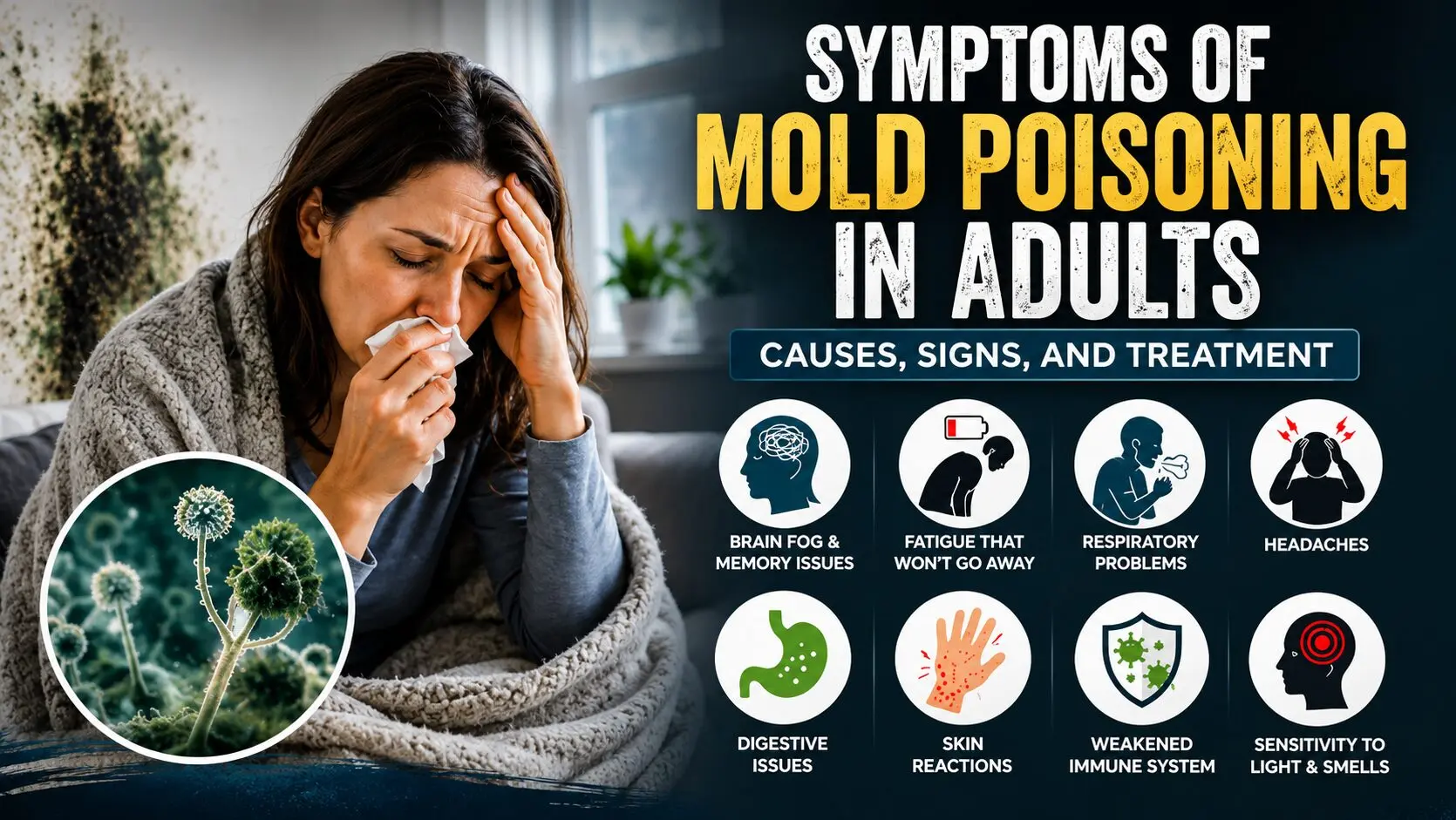
Symptoms of Mold Poisoning in Adults
What makes the symptoms of mold poisoning in adults so difficult to catch is that they look like a dozen other conditions. The average adult with mold poisoning visits three to five different doctors before anyone figures out what is actually going on, and most of those visits result in treatment of individual symptoms without ever finding the cause.
Breathing Problems That Come and Go
Your respiratory system encounters mold spores first because inhalation is the primary exposure route. The symptoms that show up early include nasal congestion that never fully clears, a lingering cough that improves slightly and then returns, post-nasal drip, recurring sinus infections, and a tightness in your chest that is noticeably worse when you are at home.
A lot of adults with mold poisoning spend years being treated for seasonal allergies or chronic sinusitis. The American Academy of Allergy, Asthma and Immunology has confirmed that mold is a direct trigger for asthma symptoms in around 21 million Americans. If you have never had breathing problems before and they started without any clear trigger, poor indoor air quality from mold is worth investigating seriously.
Brain Fog and Memory Problems
This is the symptom that tends to scare people the most, and understandably so. Mycotoxins are neurotoxic. They cross the blood-brain barrier and interfere with how your brain produces and uses neurotransmitters. What that looks like in daily life is not being able to hold a thought, forgetting things you just heard, struggling to find words in the middle of a sentence, feeling mentally slow in a way that is hard to explain to someone who has not experienced it.
A study from 2003 found that adults living or working in water-damaged buildings performed measurably worse on neuropsychological tests compared to people in clean environments, with real, documented deficits in memory, learning speed, and processing ability. These cognitive symptoms significantly overlap with what is listed among the 10 warning signs of mold toxicity, and recognizing that overlap early is often what leads people finally to the right diagnosis.
Fatigue That Sleep Does Not Touch
This is the symptom that most mold poisoning patients describe first and most urgently. It is not feeling sleepy. It is a physical depletion that sleep does not fix because it has nothing to do with how rested you are. Mycotoxins, particularly trichothecenes from Stachybotrys, attack mitochondrial function directly. Your mitochondria are what produce energy inside your cells. When they are compromised, your body runs low on fuel at a cellular level, and no amount of rest changes that. This type of exhaustion is one of the most consistent signs of mold poisoning in adults, regardless of age, fitness level, or lifestyle.
Mood Changes Nobody Can Explain
If your anxiety got noticeably worse for no clear reason, or if you have been feeling depressed and the usual approaches are not helping, mold deserves consideration as a contributing factor. Mycotoxins interfere with the production of serotonin and dopamine. Those are not minor players; they are the primary chemicals your brain uses to regulate mood and emotional stability. Disrupting them creates a real biochemical basis for anxiety and depression, not a psychological one. Many adults notice that their mental health started declining after a move, a renovation, or a plumbing problem in their home. That timing matters, and it is worth paying attention to when you notice water damage that preceded a shift in how you feel emotionally. Getting professional mold testingdone sooner rather than later in that situation is always the right call.
Body Pain Without a Clear Cause
Widespread joint pain and muscle aches that move around, feel worse in the morning, and have no obvious physical cause are among the more frustrating signs of mold poisoning in adults because they match fibromyalgia so closely. What is actually happening is that mycotoxins are triggering the release of pro-inflammatory compounds called cytokines — specifically IL-6 and TNF-alpha throughout your body. These drive systemic inflammation that produces real, physical pain in muscles and joints. Many adults with mold poisoning spend years in fibromyalgia treatment before the environmental source of their inflammation is ever identified.
Gut Problems That Came Out of Nowhere
If you suddenly have food sensitivities you never had before, or if bloating, nausea, and digestive unpredictability have become part of your normal life without any clear dietary explanation, mold may be involved. Research published in Comprehensive Reviews in Food Science and Food Safety confirmed that specific mycotoxins, including ochratoxin A and aflatoxins, directly damage the cells lining your intestinal wall, leading to leaky gut syndrome. Once the gut lining is compromised, your immune system starts reacting to food particles that would normally never cause a problem, which explains the sudden appearance of new food sensitivities in mold-exposed adults.
Skin That Reacts Without Reason
Your skin is an elimination organ. When your body is carrying a toxic load, it cannot process fast enough through normal channels, and it tries to push toxins out through the skin. For adults with mold poisoning, this shows up as unexplained rashes, hives, persistent itching, skin that flushes for no apparent reason, or a crawling sensation just beneath the surface. These reactions almost always get treated as eczema or contact dermatitis without anyone investigating the internal overload that is actually causing them. If your skin issues arrived alongside fatigue, respiratory problems, or brain fog, mold exposure is a legitimate common thread worth exploring.
Getting Sick All the Time
Research from the NIH confirms that specific mycotoxins, including aflatoxins and ochratoxins, are clinically classified as immunosuppressants. They do not just irritate your immune system. They reduce its functional capacity at a measurable, documented level. Adults dealing with mold poisoning start catching every bug that circulates, take significantly longer to recover than they used to, and find that infections like sinus problems or UTIs keep coming back weeks after they appeared to clear. Mold remediation of the living environment is the only intervention that actually addresses why the immune system is struggling, not just the infections it keeps failing to fight off.
Becoming Sensitive to Everything
Light that gives you an instant headache. Noise that feels physically painful. Smells that used to be neutral but now cause nausea. These are neurological symptoms of mold poisoning in adults that almost nobody connects to mold without prior knowledge of this pattern. They develop because mycotoxins keep the central nervous system in a near-constant state of threat response. Sensory inputs that a healthy nervous system filters out become overwhelming because the filtering mechanism has been compromised.
The EPA estimates that 50% of U.S. buildings have experienced water damage at some point, and water damage that was never properly addressed is the starting point for the vast majority of toxic mold situations. Knowing how to test for mold inside walls after any water intrusion event is one of the most protective steps a property owner can take before health consequences develop.
Long-term low-level exposure is more dangerous than people tend to assume. Sleeping in a mold-affected bedroom every night or working in a contaminated office for eight hours a day means your body is absorbing mycotoxins faster than it can eliminate them. This is why black mold health effects in adults often feel like a slow, confusing deterioration rather than a sudden, obvious illness.
Genetics plays a significant role that most people are completely unaware of. Adults carrying the HLA-DR variant simply cannot clear mycotoxins the way others can, which means the same environment that leaves one person feeling fine leaves another in a genuine health crisis.
Existing health conditions lower the threshold further. Adults with autoimmune disorders, asthma, or any condition that already taxes the immune system will experience more severe mold poisoning symptoms at lower exposure levels than healthy adults.
Getting a Diagnosis
No single test confirms mold poisoning on its own. Getting an accurate diagnosis means combining clinical assessment with targeted laboratory testing, ideally with a physician who has experience in environmental medicine or biotoxin illness.
Mycotoxin urine panels from labs like Great Plains Laboratory or Vibrant Wellness measure the mycotoxin metabolites your body is actively excreting. Inflammatory blood markers, including TGF-beta1, C4a, and MMP-9, show the specific immune dysregulation pattern that biotoxin illness produces. The Visual Contrast Sensitivity test is a simple, inexpensive tool that screens for neurological impairment consistent with biotoxin exposure. HLA-DR genetic testing tells you whether your biology places you in the high-susceptibility category.
Testing your home environment is just as important as testing your body. Mold toxicity treatment cannot produce lasting results if you are still breathing contaminated air every day. FixMold’s certified inspectors conduct detailed air and surface sampling that identifies exactly what species are present and at what concentrations, giving your physician the environmental data they need alongside your clinical results.
FixMold Can Help You Get to the Root of It
Knowing the symptoms of mold poisoning in adults is genuinely useful. But symptoms alone do not get better as long as the mold source stays active in your home.
FixMold has worked alongside hundreds of families where adults spent months or years in declining health before anyone identified what their home was doing to them. Our certified specialists bring comprehensive mold inspection and testing to every job, trace contamination back to its moisture source, and carry out professional remediation backed by post-treatment verification. You do not have to guess whether your home is safe after we are done. You have the documentation to prove it.
Suppose this article sounds like your life; do not wait for your symptoms to get worse before acting on them. Contact FixMold and let us look at what is actually going on inside your home.
Frequently Asked Questions
Q1: What are the first symptoms of mold poisoning in adults to watch for? Respiratory symptoms tend to show up earliest. Nasal congestion that does not clear, a cough that keeps coming back, and post-nasal drip that antihistamines do not touch are common first signals. Fatigue that feels out of proportion to your activity level and headaches that are noticeably worse at home than elsewhere often come alongside them. The clearest pattern to watch for is symptoms that get better when you are away from home for several days and return shortly after you come back. If that is happening consistently, scheduling a professional mold inspection should be your immediate next step.
Q2: How fast do the symptoms of mold poisoning develop in adults? It depends on the mold species, the concentration of exposure, and your individual biology. A very heavy acute exposure can produce symptoms within hours. In most cases, though, the signs of mold poisoning in adults build slowly over weeks or months of daily low-level exposure, which is part of why they are so easy to miss. Adults often attribute the gradual decline to stress or getting older before the environmental cause gets identified. Understanding the health effects of black mold exposure specifically can help you recognize this slow-building pattern earlier.
Q3: Can the symptoms of mold poisoning in adults actually be reversed? For most people, yes. Remove the exposure source, get the right medical support, and recovery is genuinely achievable. Respiratory symptoms and fatigue tend to improve first. Brain fog and memory issues take longer because mycotoxins affect the central nervous system at a deeper level. Adults with the HLA-DR variant typically need a longer, more carefully managed treatment process, but they do recover. The key is that recovery starts with certified mold remediation of the living environment, not just medical treatment in isolation.
Q4: How do you know if your symptoms are from mold or something else? The most reliable indicator is the location pattern. If you consistently feel worse at home, better on vacation or extended trips away, and worse again within a day or two of returning, your home environment is almost certainly a factor. Clinical testing through mycotoxin urine panels and inflammatory blood markers gives you the medical data, and a professional inspection of your home gives you the environmental data. Together, they build a clear picture. FixMold inspection results have directly shaped the diagnosis and treatment of many adults who had been through multiple inconclusive medical workups before this connection was made.
Q5: Are the signs of mold poisoning in adults different from a regular mold allergy? Very different. A mold allergy is a localized immune reaction, typically affecting the respiratory system and eyes with sneezing, congestion, and watery eyes. Signs of mold poisoning in adults go system-wide, reaching the neurological system, the gut, the immune system, mood regulation, and hormonal function all at once. Allergy symptoms usually clear up fairly quickly once the mold source is removed. Mold poisoning, especially in adults with HLA-DR susceptibility, requires active medical treatment even after the environment is cleaned up because mycotoxins are embedded in body tissues and need to be actively cleared. We cover this difference in more detail in our guide on the difference between mold allergy and mold toxicity.
Q6: What foods should adults cut out during mold poisoning recovery? Any food that carries a naturally high mycotoxin load adds to the burden your body is already trying to clear. The main ones to cut during recovery are corn and anything made from it, peanuts and peanut butter, wheat, all forms of alcohol, standard coffee unless it is certified mold-free, dried fruits, and aged cheeses. Building your diet around fresh vegetables, clean proteins, and healthy fats while mold detoxification is underway reduces the inflammatory pressure on your system and gives your gut a better environment to heal in.
Q7: When should an adult actually see a doctor about this? If three or more symptoms from this article apply to you, particularly fatigue, cognitive symptoms, and respiratory issues together, and those symptoms are clearly worse at home than anywhere else, that warrants a medical conversation. Go in with notes: when symptoms started, what makes them worse, and whether they improve when you are away. At the same time, arrange a professional mold inspection with FixMold so your doctor has real environmental data to work with alongside your clinical picture. That combination gives you the fastest, most direct path to an answer.
milly g
Milly is a content contributor at FixMold with a focus on mold inspection, remediation strategies, air quality improvement, and property protection. She shares practical insights and educational resources to help homeowners and businesses maintain safer, cleaner indoor environments.