Three weeks after Hurricane Ian swept through Southwest Florida, a homeowner in Cape Coral called us about a smell in his living room. He had dried the visible water himself, repainted over the stained baseboards, and figured the problem was handled. The house looked fine. It did not smell fine.
When our team opened the wall cavity behind his entertainment unit, we found Chaetomium and Aspergillus colonies covering nearly every square inch of the drywall’s interior face. His seven-year-old daughter had been waking up with nosebleeds. His wife had developed a persistent cough that their doctor attributed to allergies. He had been dealing with headaches he assumed were stress.
None of them had connected any of it to the wall three feet away from where they watched television every evening.
That story is not unusual. In fifteen years of working with water-damaged properties across South Florida, I have seen versions of it more times than I can count. And the question I hear most consistently from homeowners in those situations is the same one you are probably asking right now.
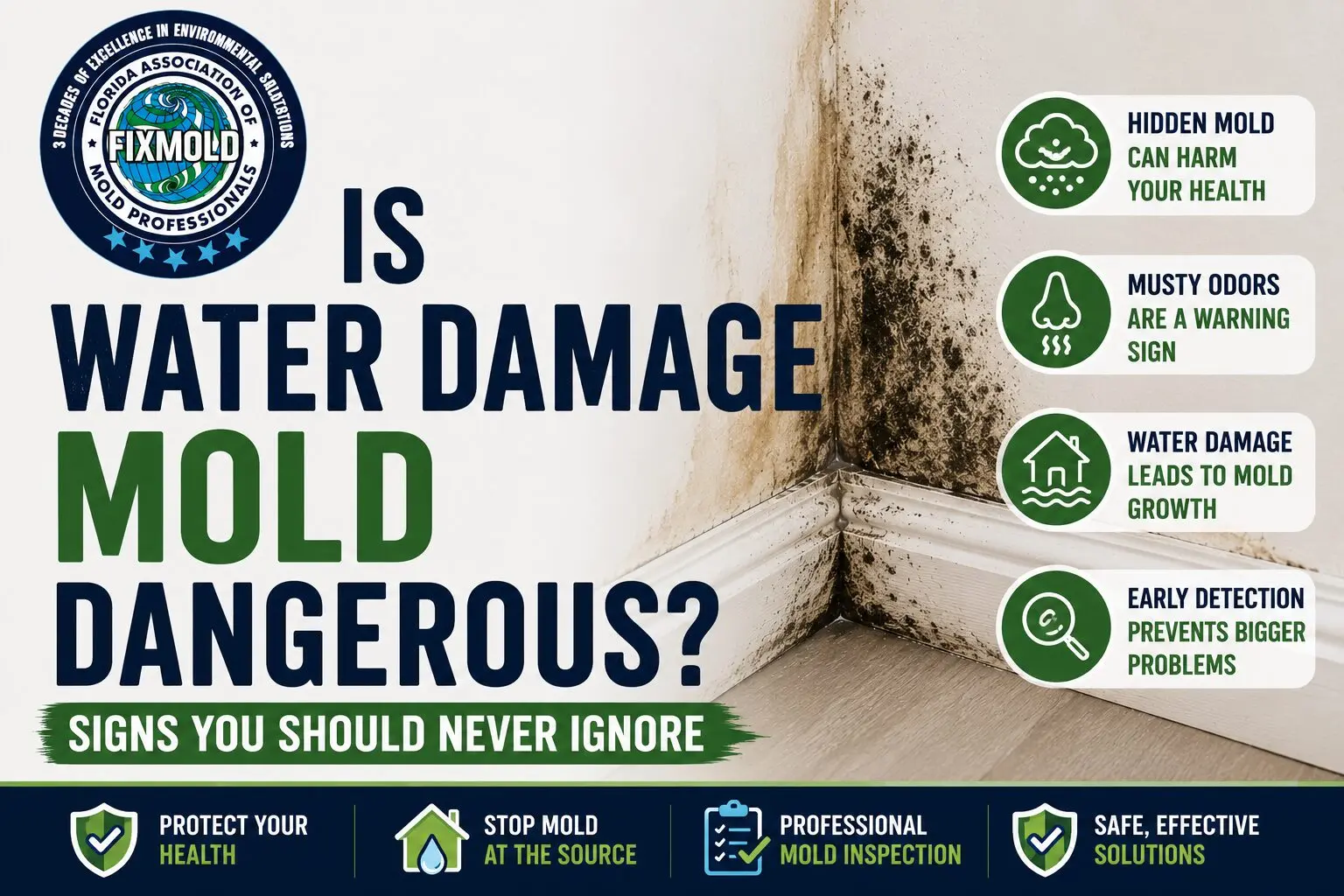
Is water damage mold dangerous?
The answer is yes. And the delay in finding out is usually what makes it worse.
Why Water Damage and Mold Are Inseparable
A lot of homeowners treat water damage and mold as two separate problems that may or may not be connected. They are not separate. They are sequential. One leads to the other with a reliability that fifteen years in this field have made entirely predictable to me.
When water enters your home, whether from a burst pipe, a roof leak after a storm, a slow drip behind a cabinet, flooding, or an appliance that overflowed once and seemed fine afterward, it soaks into porous building materials faster than the surface suggests. Drywall, wooden framing, ceiling tiles, subfloor material, insulation. All of these absorb and hold moisture long after the visible water is mopped up and the surface feels dry.
The EPA has documented that mold can begin colonizing a damp surface within 24 to 48 hours of water exposure under the right conditions. Wall cavities are dark, warm, and packed with the organic cellulose material that mold feeds on. Once moisture gets in there, you are not working with a generous timeline.
So when someone asks me is water damage mold dangerous, my first question back is always: how long has the moisture been there? Because the danger compounds with time in ways that affect both your building’s structural integrity and your family’s health simultaneously.
Is Water Damage Mold Dangerous to Your Health?
Let me answer this directly and without the hedging that makes most articles on this topic frustrating to read.
Yes, mold from water damage is harmful. The degree of harm depends on several factors, including which species is growing, how large the colony has become, how long exposure has been happening, and the individual biology of the people in the home. But the baseline answer is yes, and assuming otherwise is a gamble with consequences that can take months to become fully apparent.
The CDC acknowledges that indoor mold exposure causes upper respiratory symptoms in otherwise healthy adults and worsens asthma in people with an established diagnosis. Research published in the American Journal of Public Health found that children living in damp, mold-affected homes have a 40% higher risk of developing asthma than those in clean, dry environments. The WHO estimates that up to 50% of indoor environments in developed countries are damp enough to support active mold growth, yet most occupants have no idea.
How dangerous is mold from water damage specifically, compared to mold that develops from other causes? In my experience, it tends to be worse for several reasons. Water damage events typically saturate larger areas of building material than surface condensation does. They occur in concealed spaces like wall cavities and subfloors where colonies can grow very large before anyone discovers them. And the moisture often persists for longer than people realize because the visible surface dries before the interior does.
The result is that by the time a homeowner notices something is wrong, they have often been living with an established, active colony for weeks or months rather than days.
The Health Effects You Need to Know About
Is mold from water damage harmful to every system in your body? Not exactly. But it affects more systems than most people expect, and the pattern of symptoms is what makes it so consistently misdiagnosed.
Respiratory System Effects
The respiratory system is always first. Mold spores and mycotoxins enter the body primarily through inhalation. Chronic nasal congestion that antihistamines barely touch, a cough that cycles back before it fully clears, post-nasal drip, recurring sinus infections, and in people with asthma, significantly worsened and more frequent attacks. The American Academy of Allergy, Asthma and Immunology confirms that mold is a documented trigger in approximately 21 million asthmatic Americans.
Brain and Nervous System Effects
The brain and nervous system feel it next. Mycotoxins produced by water damage mold species, including Stachybotrys, Aspergillus, and Chaetomium, are neurotoxic compounds that cross the blood-brain barrier. Brain fog, difficulty concentrating, short-term memory problems, and recurring headaches are among the neurological signs that appear in people with significant indoor mold exposure. These are also among the symptoms most consistently dismissed by physicians who have not yet considered an environmental cause. Understanding the full range of Symptoms of Mold Poisoning helps connect these seemingly unrelated complaints to a single environmental source.
Immune System Suppression
Immune suppression becomes the long game. The NIH classifies specific mycotoxins produced by water damage mold species as immunosuppressants. Adults and children in heavily contaminated environments catch more illnesses, fight them off more slowly, and find that infections they would normally clear in a week drag on for three or four. The family in Cape Coral I mentioned at the opening of this article fit this pattern exactly.
Skin and Digestive System Effects
Skin and digestive complaints show up when the toxic load accumulates beyond what primary elimination pathways can handle. Unexplained rashes, hives, nausea, bloating, and new food sensitivities appearing without dietary changes are all documented in people with prolonged water damage mold exposure, though these tend to appear later than respiratory symptoms.
Why “It Looks Dry” Is Never Enough
This is the mistake I see most often and the one that costs homeowners the most money and the most health consequences over time.
After a water event, most people assess the situation visually. The carpet dried. The floor looks fine. The wall feels dry to the touch. The visible stain is faded or painted over. Problem solved.
Except that drywall dries from the outside in. The paper facing of drywall, which is a cellulose product that mold feeds on, dries relatively quickly with airflow. The gypsum core holds moisture significantly longer. The wooden studs behind the drywall hold moisture longer still. And the insulation between studs, if saturated, can retain moisture for weeks or months while remaining completely invisible from the surface.
By the time you can touch a wall and feel nothing, the interior of that wall cavity may still be at moisture content levels that actively support mold colonization. Professional moisture meters and infrared thermal imaging cameras detect what hands cannot, which is exactly why professional mold inspection after any significant water event is not optional if you want an accurate picture of what is actually happening inside your building materials.
I have walked into properties six months after a water event where the homeowner was genuinely shocked by what our thermal imaging showed. The wall looked perfect. The inside of it was not.
Is Black Mold from Water Damage More Dangerous?
Is black mold from water damage dangerous in a way that other mold species are not? This question comes up constantly and deserves a direct answer.
Stachybotrys chartarum, the species most commonly called black mold, does produce trichothecene mycotoxins that have been studied extensively for their effects on human health. It requires prolonged moisture on cellulose materials to establish growth, which means its presence almost always indicates a water damage situation that has been ongoing for some time rather than a brief, acute event.
The CDC’s position is that black mold exposure should be taken seriously and that affected materials should be remediated, while also noting that the evidence connecting Stachybotrys to unique or dramatically more severe health effects compared to other indoor molds in healthy adults is still developing.
What I tell homeowners is this: the color of the mold is the least important thing about it. What matters is that it is growing on building materials in your home, that it is releasing spores into the air your family breathes, and that it got there because moisture was present and unresolved. Whether the colony is black, green, gray, or white, the appropriate response is the same. Professional assessment and proper remediation.
Attempting to identify mold species by color and using that identification to decide whether to act is a mistake I have seen cost families significantly in both health outcomes and remediation costs that grew larger while they waited.
Signs Your Water Damage Has Already Become a Mold Problem
Knowing is water damage mold dangerous is one question. Knowing whether you already have it is another. These are the signals that warrant immediate assessment rather than watching and waiting.
A Persistent Musty Odor
A musty odor that persists. Mold produces microbial volatile organic compounds as part of its metabolic activity. That earthy, musty smell is those compounds entering your air even when the growth itself is hidden inside a wall or under flooring. If a room smells off even after cleaning and airing out, the source is inside the building materials, not on the surface.
Wall, Ceiling, or Baseboard Discoloration
Discoloration on walls, ceilings, or baseboards that appeared or worsened after a water event. Yellowish-brown staining, dark streaks, or paint that looks like it is being stained from behind rather than from the surface are all indicators of moisture-driven growth inside the wall.
Bubbling or Peeling Paint and Wallpaper
Paint or wallpaper bubbling, peeling, or separating from the wall surface indicates moisture is building up behind it. Where moisture is present on an organic surface in a warm, dark, enclosed space, mold is almost certainly following.
Health Symptoms That Improve Away From Home
Health symptoms following the location pattern. If household members feel worse at home than they do at work, school, or during travel, and the difference is consistent and noticeable, the home environment is the logical investigative priority.
Health Symptoms That Improve Away From Home
Previous water events that were not professionally dried. If your home had a leak, flood, or water damage situation in the last one to three years that was handled without professional drying equipment and moisture verification, there is a meaningful chance that mold established in areas that were not adequately dried within the 48-hour window.
What Proper Remediation Actually Requires
Understanding how dangerous mold from water damage is also means understanding that the response to it matters enormously. Cleaning the visible surface with bleach and repainting is not remediation. It is concealment.
Bleach does not penetrate porous materials. It kills surface growth while leaving the hyphae, the root structure of the mold colony, intact inside the drywall or wood. The mold looks gone. It regrows from the intact root system within weeks, often more aggressively because the surface cleaning altered the material’s chemistry in ways that favor regrowth.
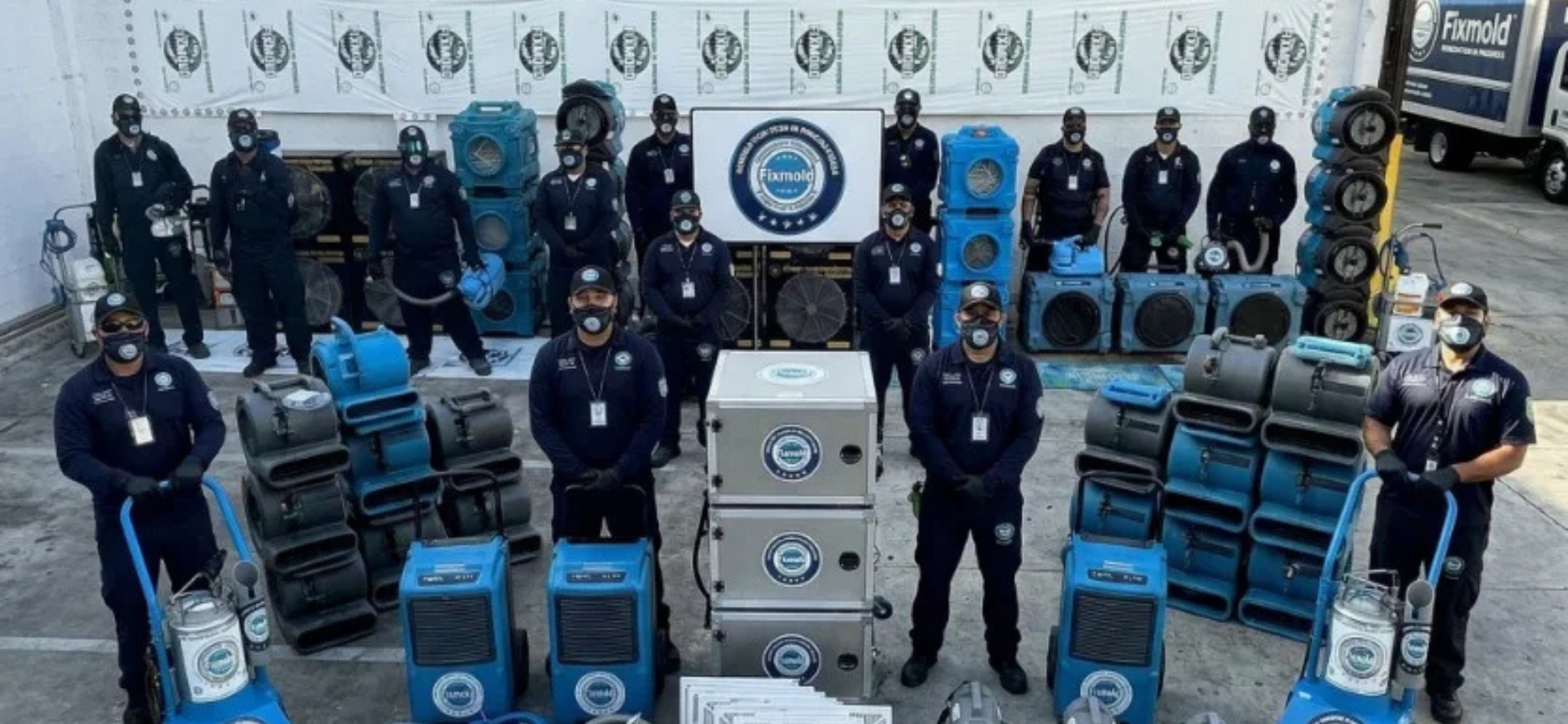
Actual remediation involves containment that prevents spores from spreading to unaffected areas during the removal process, removal and proper disposal of contaminated porous materials, antimicrobial treatment of structural surfaces that addresses the root hyphae rather than surface growth, HEPA filtration systems running throughout the remediation process to capture airborne spores, and post-remediation air quality testing that verifies through laboratory results that spore levels have returned to normal baseline.
HEPA filtration is not a supplementary step. It is a fundamental part of preventing cross-contamination during remediation because disturbing a mold colony releases spore concentrations dramatically higher than the colony was producing while undisturbed. Without proper HEPA air scrubbing running continuously during the work, those spores travel through your home and settle in areas that were previously clean.
FixMold: The Right Call After Water Damage
At FixMold, we have worked alongside hundreds of families dealing with water damage mold situations across South Florida, and the pattern I see in the cases that end up being most costly and most harmful to health is always the same. Someone waited.
They waited to see if the smell went away. They waited until the health symptoms became impossible to ignore. They waited until a physician finally asked about the home environment. They waited until a real estate transaction required a mold inspection that revealed what had been growing for months.
The cost of finding out early, through professional mold inspection and professional mold testing that includes laboratory-certified air and surface sampling, is a fraction of what remediation costs after a colony has been established for six months in a wall cavity feeding off an unresolved moisture source.
If your home has experienced any water damage event in the last year, if you are noticing a smell that does not respond to cleaning, or if household members are dealing with health symptoms that are consistently worse at home than elsewhere, contact FixMold for a comprehensive inspection.
We use calibrated moisture meters, infrared thermal imaging, and laboratory-certified air sampling to give you an accurate, documented picture of what is actually happening inside your building materials. Not a guess. Not a visual estimate. An evidence-based assessment that tells you exactly what you are dealing with and what it will take to resolve it properly.
Frequently Asked Questions
Q1: Is water damage mold dangerous even if I cannot see any growth?
Yes, and hidden growth is actually the more common and more concerning scenario. Mold establishes inside wall cavities, under flooring, above ceiling tiles, and inside HVAC components where it can develop into large colonies without any visible surface indication. The first visible sign on a painted drywall surface often represents growth that has been active inside the wall for weeks or months. A musty odor without visible mold is itself a reliable indicator of hidden active growth and warrants professional assessment.
Q2: How quickly does mold develop after water damage?
The EPA documents that mold can begin colonizing a damp surface within 24 to 48 hours under favorable conditions. Wall cavities provide consistently favorable conditions, including darkness, warmth, organic material, and limited airflow. Materials that were not completely dried within that initial window should be assumed to have developed mold growth, particularly in South Florida’s climate, where ambient humidity accelerates the process relative to most of the country.
Q3: Is mold from water damage harmful if it is a small area?
The visible area is almost never the complete picture. Small surface patches are connected to root structures and growth that extends through porous materials beyond the visible boundary. A patch that appears to cover four square feet on the surface may be connected to growth covering the entire back face of a sheet of drywall. Additionally, even small active colonies release spores continuously into your indoor air in concentrations that can affect sensitive individuals. The size of visible growth is not a reliable indicator of health risk or total remediation scope.
Q4: Is black mold from water damage dangerous than other water damage mold species?
All significant indoor mold growth from water damage situations warrants remediation regardless of species. Is black mold from water damage dangerous? Yes, Stachybotrys chartarum produces documented mycotoxins, and its presence indicates prolonged moisture exposure. But other species that develop from water damage events, including Aspergillus, Chaetomium, and Penicillium, also produce compounds harmful to human health and should be treated with equal seriousness. Species identification requires laboratory testing, not visual assessment of color.
Q5: How dangerous is mold from water damage for children specifically?
Children face elevated vulnerability to water damage mold for several reasons. Their respiratory systems are still developing; they breathe more air relative to their body weight than adults, and they typically spend more time in indoor environments. Research published in the American Journal of Public Health found a 40% increased asthma risk in children from damp, mold-affected homes. The WHO identifies children as one of the primary at-risk groups for mold-related health effects. Any water damage situation in a home with children warrants faster professional assessment than the same situation in an unoccupied commercial property.
Q6: Does homeowners insurance cover mold remediation from water damage?
Coverage depends on the cause and timing of the water damage. Sudden accidental water events such as burst pipes, AC overflow, and appliance failures are typically covered under standard homeowners policies when reported promptly, including resulting mold remediation costs. Long-term slow leaks, flooding from external sources, and damage attributed to deferred maintenance are frequently excluded. Professional documentation of both the water damage origin and the resulting mold growth, combined with prompt reporting to your insurer, gives you the strongest claim position. FixMold’s documentation process is specifically designed to support insurance claims effectively.
Milly is a content contributor at FixMold with a focus on mold inspection, remediation strategies, air quality improvement, and property protection. She shares practical insights and educational resources to help homeowners and businesses maintain safer, cleaner indoor environments.