A homeowner in Coral Springs once called us about a dark patch spreading across her bedroom wall. She’d scrubbed it with bleach spray three times. Each time, it came back within two weeks, darker and a little bigger.
Her husband blamed cheap paint. A neighbor guessed ventilation. A handyman said to caulk the window and repaint. None of them were entirely wrong, but none were asking the right question.
The right question isn’t just what causes mold on walls in a house. It’s what’s allowing moisture to sit in that wall long enough for mold to keep coming back because mold doesn’t return because you missed a spot while cleaning. It returns because whatever created it was never actually fixed.
In her case, a pinhole leak in a supply line behind that exact corner was the source. By the time we found it, the colony had spread across nearly four feet of drywall that looked fine from the outside.
Here’s what actually causes wall mold, what it can do to your health, and why cleaning the surface rarely solves the real problem.
How Mold Actually Gets on Walls
Mold is a fungus that spreads through microscopic spores present in nearly every indoor space, all the time. They drift in through windows, HVAC systems, and doorways constantly, and on their own they’re harmless.
The trouble starts when spores land somewhere with three things: moisture, an organic surface to feed on, and warmth. Drywall paper, wood framing, and paint compounds supply the food. South Florida supplies warmth year-round, no help needed. Moisture is the one factor homeowners can actually control which is why controlling it is really the only long-term defense.
The EPA notes mold can begin colonizing a damp surface within 24 to 48 hours. That’s fast enough that a slow pipe drip, a poorly sealed window during a storm, or a bathroom with weak airflow can quietly sustain a colony for days before anything looks wrong.
What Causes Mold on Walls in a House
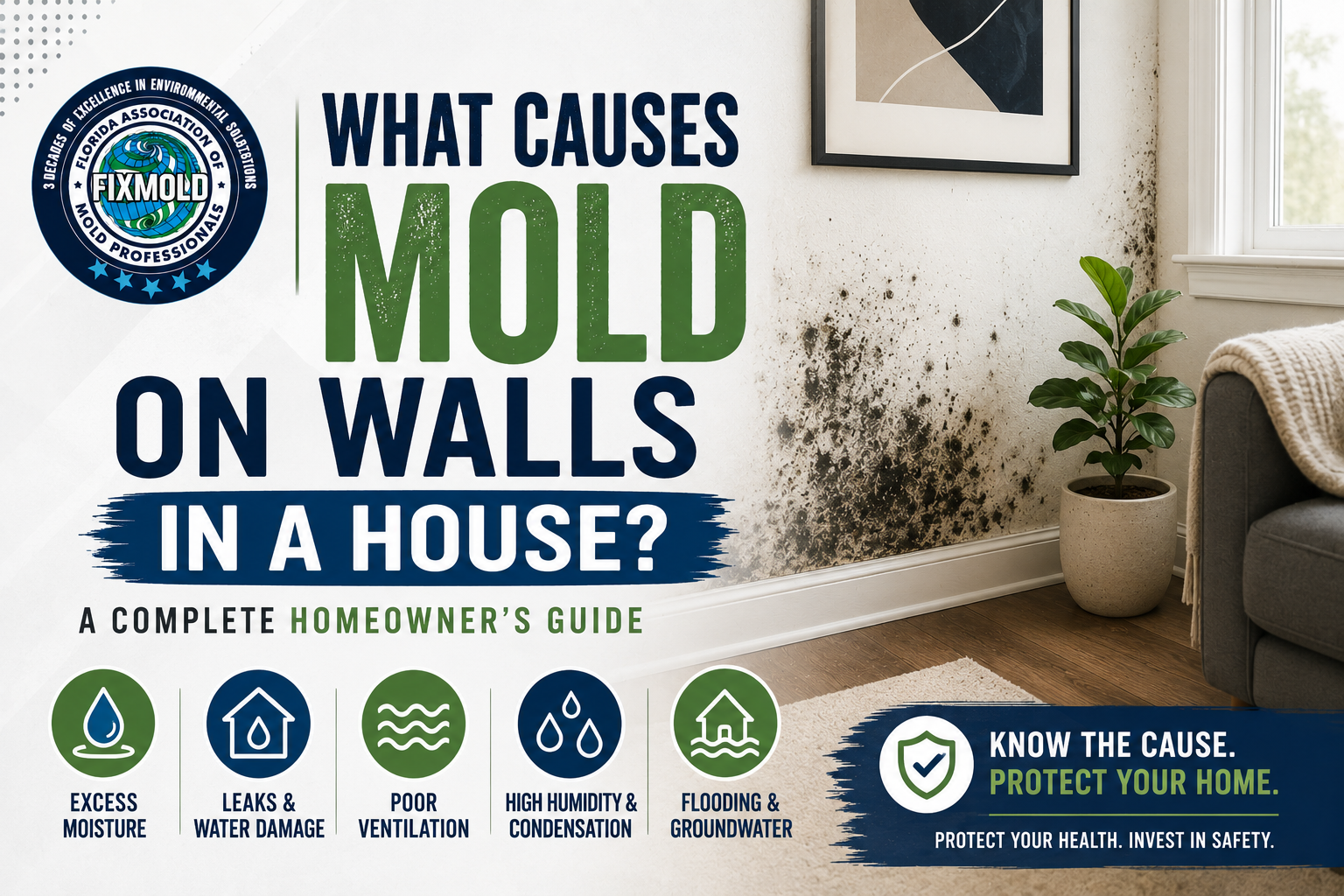
There’s no single answer, since the moisture source varies by room, construction type, and how a home is used. But most cases we see fall into a handful of categories.
Plumbing Leaks Inside the Wall
Plumbing leaks inside the wall. This is the one homeowners rarely suspect until a wall gets opened up. A slow drip from a loose fitting or a pinhole in an aging copper pipe can feed a wall cavity for months without ever showing on the painted surface. That cavity dark, warm, and starved of airflow is close to a perfect mold incubator. By the time a stain appears, the growth inside is usually far more extensive than the mark suggests.
Condensation on Exterior Walls
Condensation on exterior walls. In colder states, condensation happens when warm indoor air hits cold walls in winter. Florida runs the opposite way: hot, humid outdoor air meets interior surfaces cooled by aggressive air conditioning. Because summer air here carries such a high dew point, almost any sufficiently cooled surface can start condensing. Weak insulation, thermal bridging through metal framing, or gaps in the vapor barrier let this happen invisibly inside the wall for a long time before mold shows up. ASHRAE recommends keeping indoor humidity between 30% and 50%, but many South Florida homes exceed that whenever the AC can’t quite keep pace.
Poor Bathroom and Kitchen Ventilation
Poor bathroom and kitchen ventilation. A ten-minute hot shower dumps a surprising amount of moisture into the air, and it lingers on walls long after the water’s off, especially in corners and along the ceiling line, where airflow is weakest. Bathrooms with undersized, badly vented, or rarely-used exhaust fans are some of the most common mold locations in any home. Kitchens face a similar issue from cooking steam, dishwasher exhaust, and the warm, humid air around the fridge.
Roof Leaks That Travel Sideways
Roof leaks that travel sideways. Water entering through cracked tiles or failed flashing doesn’t always drip straight down; it often runs along the roof deck first, showing up in a wall that seems unrelated to the actual damage. Storm season is when this shows its teeth: a flashing detail that handled ordinary rain for years can fail under wind-driven rain, and tracing that water can be genuinely hard without thermal imaging.
Flooding and Water Intrusion
Flooding and water intrusion. Any flood, appliance failure, or backup that isn’t professionally dried within that 48-hour window sets mold up to establish. Homeowners often assume they’re in the clear because the surface feels dry but drywall dries from the outside in, and the cavity can stay wet for weeks after the paint feels fine to the touch. Fast, professional water damage restoration in the days after an intrusion is the single best way to keep mold from ever getting a foothold in the first place.
Chronic High Indoor Humidity
Chronic high indoor humidity. In South Florida, a home without properly functioning AC and dehumidification will eventually develop wall mold. It’s a matter of when, not if. Outdoor humidity here averages above 75% for much of the year and often tops 90% in summer. When indoor humidity isn’t kept below 60%, walls throughout the house, particularly in rooms with poor airflow, stay damp enough to support growth with no specific leak involved. This shows up most in vacation homes with the AC set low during long absences, aging HVAC systems that can’t keep up, and rooms cut off from the main air circulation.
Moisture Sources Homeowners Usually Miss
A few pathways surprise people almost every time we find them: poorly sealed window and door frames that let wind-driven rain wick into the framing without an obvious puddle; HVAC vents blowing directly on a wall, which can create a localized cold spot that condenses in a pattern matching the airflow (this is one of the more common triggers we see for HVAC mold remediation calls); concrete block walls absorbing ground moisture through capillary action, showing up as peeling paint or recurring mold low on the wall; and metal stud framing, which creates thermal bridges that collect condensation in linear patterns tracing the studs.
Can Mold on Walls Make You Sick?
Yes, though how much it affects you depends on the species, whether it’s actively growing, the size of the affected area, and your own health and genetics.
Public health guidance links mold exposure to upper-respiratory symptoms in healthy adults and worse outcomes for people with asthma or allergies. Research on children in damp, mold-affected homes has found meaningfully higher asthma rates than in dry homes, and global estimates suggest a large share of indoor environments in developed countries have dampness significant enough to affect the people living there.
It’s not just people with existing conditions who react. Persistent coughing, congestion, headaches, and fatigue show up in otherwise healthy adults after sustained exposure. Mycotoxin-producing species like Stachybotrys, Aspergillus, and Chaetomium have been linked to brain fog, memory trouble, and mood changes symptoms people often blame on something else long before connecting them to their home.
One pattern clinicians watch for: symptoms that ease after a few days away from home and return within a day or two of coming back. That timing is usually the strongest clue the indoor environment is the actual cause, whether or not visible mold has turned up yet.
There’s a genetic angle too. Roughly a quarter of the population carries a gene variant that makes it harder to clear mycotoxins through normal immune pathways, part of why two people in the same house can react so differently to identical exposure. If symptoms are showing up but you can’t find visible mold, indoor air quality testing can confirm whether spore levels in your home are actually elevated.
Why Mold Keeps Coming Back After Cleaning
This is the most common complaint we hear people clean and it comes right back, or paint over it and it bleeds through again.
The reason is straightforward: wiping the surface doesn’t touch what’s happening inside the wall, and it doesn’t fix whatever is keeping that surface damp. Bleach kills what you can see, but it doesn’t reach growth inside the paper facing or gypsum core, and it does nothing about the moisture source. Two weeks later, the surviving growth and the still-present moisture produce the same stain again.
Professional mold testing services identify what’s actually present, at what concentration, and which species are involved, information that shapes the right remediation approach and gives you a baseline to confirm the fix worked. Painting over a stain, by contrast, tends to trap moisture and mold under a surface that looks clean but is now more sealed-in than before.
Common Mistakes Worth Avoiding
- Painting over mold instead of removing it: Traps moisture and lets the colony keep growing under a surface that looks fine for a while.
- Treating bleach on drywall as remediation: It’s a surface disinfectant, not a fix for porous material.
- Fixing one moisture source and assuming that’s the whole problem: Many cases have more than one contributing cause.
- Dismissing a small patch: The size on the surface tells you almost nothing about what’s happening inside the wall.
When to Call a Professional
Bring in a professional mold inspection if mold returns more than once after cleaning, if the affected area is larger than about 10 square feet, if you can’t pin down a moisture source, if growth is near HVAC vents or ductwork, if someone in the house has symptoms that track with time at home, or if you’re buying or selling the property.
It’s worth knowing the difference between mitigation and full remediation. Mitigation contains the problem and treats the surface. Full mold remediation services remove contaminated material, treat the structure, fix the moisture source, and verify results with testing afterward. Mold that’s reached a wall cavity almost always needs the latter.
Frequently Asked Questions
What causes wall mold when there’s no visible leak?
Usually condensation inside the cavity, driven by humid outdoor air meeting AC-cooled interior surfaces. A hidden slow drip is the other common culprit. Moisture meters and thermal imaging are how professionals find these without opening up the whole wall.
Can a small patch of mold still make you sick?
Yes. A small visible patch on drywall often represents just the edge of a larger colony inside the wall, and even a modest active colony releases spores continuously enough to affect children, older adults, and anyone with respiratory sensitivities.
Why does bathroom wall mold keep coming back?
Almost always because the moisture source hasn’t been dealt with an undersized or poorly vented exhaust fan, failing grout or caulk, or a slow leak behind the fixtures. Cleaning kills what’s visible but changes nothing about the humidity feeding it.
Is black mold more dangerous than other colors?
Color alone doesn’t tell you much. Stachybotrys chartarum (commonly called black mold) does produce documented mycotoxins, but so do some lighter-colored species like Aspergillus and Chaetomium. Lab testing is the only reliable way to identify what you’re actually dealing with.
How much does fixing wall mold typically cost?
It depends heavily on scope. A small, contained area with a clearly identified and fixed moisture source might run a few hundred dollars. Mold that penetrated the cavity requiring drywall removal, structural treatment, and a moisture repair typically falls between $1,500 and $5,000. Extensive cases involving multiple walls or framing can run higher. A professional inspection gives you a real number before you commit to anything.
The Bottom Line
What causes mold on walls in a house always comes down to moisture but where that moisture comes from varies enough that cleaning the surface without investigating rarely solves anything for long. Plumbing leaks, condensation from Florida’s humidity and air conditioning, weak bathroom and kitchen ventilation, roof leaks, and unresolved flooding are the usual suspects, and it’s common for more than one to be at play at once.
Can mold on walls make you sick? Yes the effects range from mild respiratory irritation that clears up once you leave the house to more serious, systemic symptoms in people with a genetic susceptibility to mycotoxins. Because the health impact builds gradually, the connection to the home itself is often the last thing anyone considers.
Fixing it for good starts with finding the actual moisture source, not with cleaning the same spot again and hoping for a different result.
If wall mold keeps coming back, or you’ve noticed a musty smell along with symptoms that seem tied to time spent at home, the team at Fixmold can inspect your property, track down the moisture source, and give you a straight answer on what it’ll take to fix it properly. Contact Fixmold today to schedule an inspection. Catching it early is always cheaper than finding out how far it’s spread six months from now. See our full list of South Florida service areas to find the team nearest you.
Milly is a content contributor at FixMold with a focus on mold inspection, remediation strategies, air quality improvement, and property protection. She shares practical insights and educational resources to help homeowners and businesses maintain safer, cleaner indoor environments.