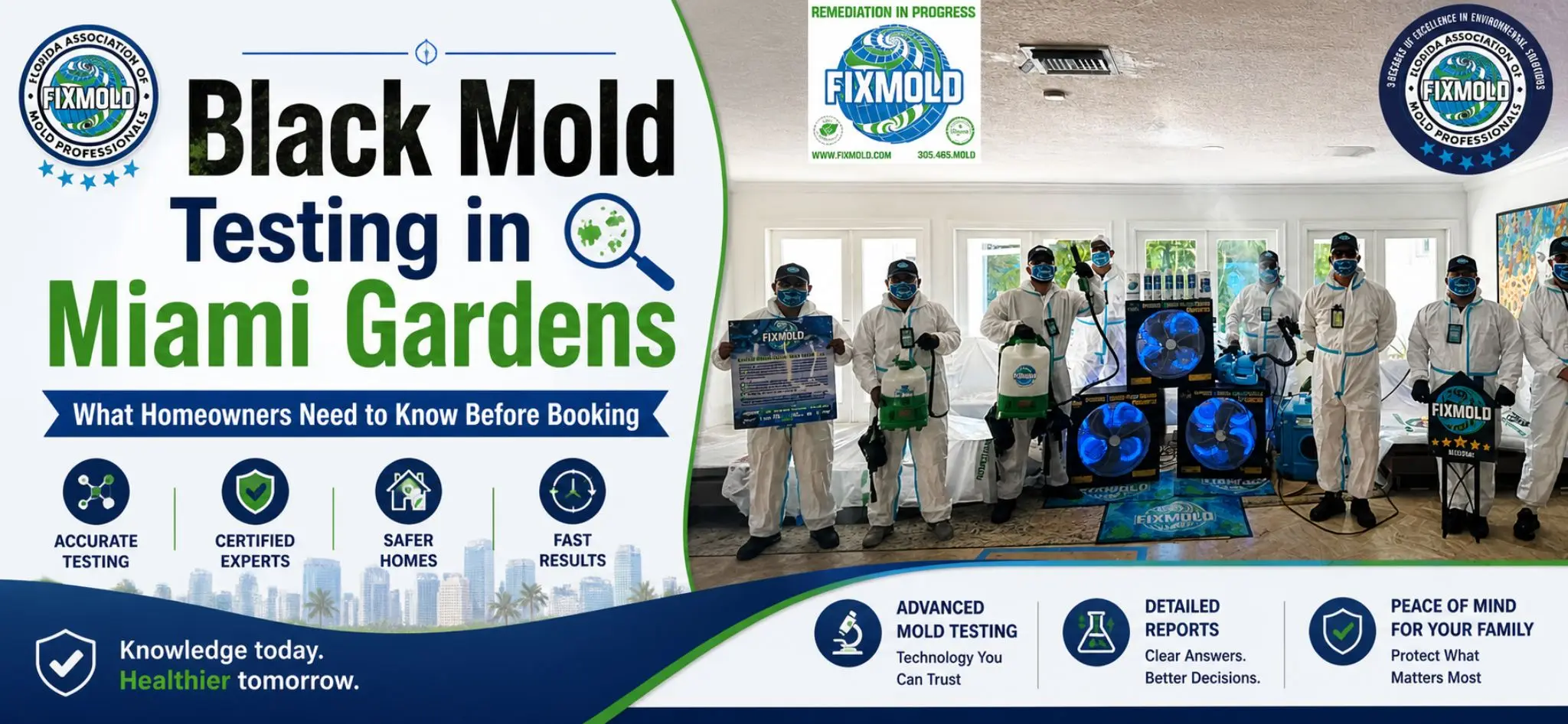
Black Mold Testing in Miami Gardens: What Homeowners Need to Know Before Booking
milly g
May 1st, 2026
No Comments
Like what we publish? Pin Fixmold Miami as a preferred source on Google.
You noticed a smell. Maybe a dark spot behind the bathroom vanity or along the base of a wall that got wet last hurricane season. You Googled ‘black mold testing Miami Gardens,’ and now you’re staring at a list of companies that all say they’re the best.
Here’s the problem: most homeowners in South Florida don’t know enough about mold testing to tell the difference between a legitimate inspection and one that’s going to waste their time. And in Miami Gardens, where humidity rarely drops below 60% and rainfall is aggressive almost half the year, mold is not a minor inconvenience. It’s a real health and structural threat.
This guide is written to give you practical knowledge before you spend a single dollar. Not scare tactics. Not a sales pitch. Just what you actually need to know.
What Is Black Mold Testing and How Does It Actually Work?
Black mold testing is a professional assessment that identifies whether mold spores, specifically those belonging to species like Stachybotrys chartarum, are present in your home’s air or on its surfaces. A certified inspector collects samples, sends them to an accredited lab, and returns results that tell you what species exist and at what concentration.
There are two main types of samples collected during a standard inspection:
Air samples (spore trap samples): Capture mold spores floating in your indoor air and compare them to outdoor air levels
Surface/bulk samples: Swabs or tape lifts taken directly from visible growth or suspicious areas
Most inspections involve both. Relying on just one type often leads to an incomplete picture, especially in older Miami Gardens homes with multiple suspect areas.
A note most companies don’t tell you upfront: the test itself doesn’t tell you how bad the problem is. It tells you what’s there. Severity comes from the inspector’s interpretation, the lab results, and the physical condition of the space. That’s why who does your inspection matters as much as the test itself.
Why Miami Gardens Homes Are Especially Vulnerable
South Florida’s climate is almost custom-designed to grow mold. Miami Gardens sits in a subtropical zone where summer temperatures stay in the upper 80s and relative humidity often hovers between 70% and 90%. Mold doesn’t need much to get started. Give it a moisture source, an organic surface like drywall or wood framing, and warmth, and it can colonize within 24 to 48 hours.
A few local factors make things worse:
Hurricane and tropical storm moisture intrusion: When water gets behind walls during a storm, it doesn’t always dry out fast enough. Mold can establish itself inside wall cavities while the surface still looks dry.
AC condensation: Homes in Miami Gardens run their AC almost year-round. Condensation on ducts and around vents is a consistent moisture source that many homeowners never check.
Flat roofs: Common in the area, and they tend to develop minor leaks over time that go unnoticed until mold is already growing in the attic or ceiling.
Older plumbing: Homes built in the 1970s through the 1990s often have small, chronic leaks that create long-term moisture problems.
Most homeowners don’t realize this until it’s too late: the mold you can see is rarely the whole story. The real growth is usually inside walls, under flooring, or in the HVAC system.
What Does a Legitimate Black Mold Inspection Include?
A thorough black mold inspection should not be a 20-minute walk-through with a flashlight. If that’s what you’re getting, it’s not enough.
Here’s what a proper inspection in Miami Gardens should cover:
Visual Assessment
The inspector examines all moisture-prone areas: bathrooms, kitchen under-sink areas, laundry rooms, utility closets, attic spaces, and anywhere with a history of water damage or leaks. They should also check the HVAC system and return air vents.
Moisture Mapping
Using a moisture meter or thermal imaging camera, the inspector identifies hidden wet areas that are invisible to the naked eye. This is non-negotiable in South Florida homes with a history of water intrusion.
At minimum, two air samples: one inside the suspect area and one outside as a baseline. This comparison tells the lab (and you) whether your indoor spore counts are elevated compared to natural outdoor levels.
Written Report
You should receive a written report with lab results, photos, moisture readings, and a clear explanation of findings. If a company quotes you for testing but doesn’t mention a written report, ask about it directly before you book.
How to Spot a Mold Testing Scam (This Happens More Than You’d Think)
Not every mold inspector operating in Miami-Dade County is playing it straight. Here’s where things usually go wrong.
Red Flag
What It Means
Free testing + immediate remediation upsell
Conflict of interest; potentially illegal in Florida without proper disclosure
Verbal-only results, no lab report
Not a real test; just an opinion
No ACAC or IAQA certification
Inspector lacks verified training and ethics standards
Testing only one spot
Mold rarely stays in one area; incomplete assessment
Understanding Your Mold Test Results
Lab reports include a spore count (measured in spores per cubic meter), species identification, and a comparison of indoor vs. outdoor air. No single number is universally ‘safe’ — what matters is whether your indoor count is significantly elevated compared to the outdoor baseline your inspector collected at the same time.
When your lab report comes back, it can feel like reading a foreign language. Here’s what to know:
Spore count: Measured in spores per cubic meter of air. Elevated indoor counts vs. outdoor baseline samples suggest a problem.
Species identification: The lab lists the genus and sometimes species. Stachybotrys (black mold) is one of the more concerning varieties, but Aspergillus, Penicillium, and Cladosporium can also cause health issues at elevated levels.
Comparative analysis: A good report compares indoor vs. outdoor results. If your bathroom sample shows 10x the spore count of your outdoor sample, that’s significant.
Your inspector should walk you through these results personally. If results confirm elevated mold levels or visible growth, the next step is professional mold remediation. Don’t try to DIY a significant mold problem with bleach — it doesn’t penetrate porous surfaces, and mold regrows within weeks.
What to Do Before the Inspector Arrives
You can improve the quality of your inspection results by doing a few things in advance.
Don’t clean or paint over suspect areas — it skews surface sample results.
Run the HVAC normally — close windows at least 12 to 24 hours before the inspection so air samples reflect your real indoor environment.
Make a list of water events — share any history of roof leaks, flooding, or plumbing problems with the inspector upfront.
Don’t panic if you see one small spot — not every dark spot is Stachybotrys. The test will tell you what you’re actually dealing with.
Conclusion: Test Smart, Not Just Fast
Mold in a Miami Gardens home is not something to guess at or ignore. But booking the first inspector you find without understanding what you’re buying is how homeowners end up with incomplete results, wasted money, and mold that comes right back. Know what a proper inspection includes. Ask about lab reports before you book. Check credentials. And if results come back positive, work with a certified remediation company that can show you their process, not just their price. Your next step: Contact the FixMold team at fixmold.com/contact/ for a no-pressure consultation. We serve Miami Gardens and the surrounding Miami-Dade County area with certified inspectors and transparent reporting.
Frequently Asked Questions
How long does a black mold test take in Miami Gardens?
Most professional mold inspections take between 1 and 3 hours depending on the size of the home and the number of areas being tested. Lab results typically come back within 3 to 5 business days. Rush processing is available for an additional fee.
Is black mold testing covered by homeowners insurance in Florida?
In most cases, the testing itself is not covered. However, if mold resulted from a covered event such as a burst pipe, your insurer may cover testing and remediation costs. Document everything with photos before filing a claim.
Can I test for black mold myself with a DIY kit?
DIY kits can confirm mold is present but can’t tell you what species it is, how concentrated the spores are, or where the source is. For any health risk or insurance claim, a professional inspection with certified lab results is the standard you need.
What are the health risks of black mold exposure in Miami?
Prolonged exposure can cause respiratory symptoms, coughing, eye irritation, skin rashes, and in sensitive individuals, more serious reactions. People with asthma, allergies, or compromised immune systems are particularly vulnerable. If anyone in your household is experiencing unexplained respiratory issues, mold testing should be a priority.
How often should Miami Gardens homeowners test for mold?
Test after any water intrusion event such as a flood, roof leak, or plumbing issue. If you’re buying an older home in Miami-Dade County, include mold testing in your inspection process. For high-humidity areas, annual air quality checks are a reasonable precaution.
Milly is a content contributor at FixMold with a focus on mold inspection, remediation strategies, air quality improvement, and property protection. She shares practical insights and educational resources to help homeowners and businesses maintain safer, cleaner indoor environments.